KI-Beratung Beta

Gutscheinbedingungen

Gültig bis 30.11.2026 | Gültig für nicht preisgebundene fremdsprachige Bücher | Einzelne Artikel können ausgeschlossen sein | Online auf thalia.de und in der Thalia App einlösbar | Click & Collect nur mit Online-Zahlung (Paypal/Kreditkarte) vorab | Nicht kombinierbar mit anderen Gutscheinen oder Preisaktionen | Nur einmal pro Einkauf einlösbar | Gutschein wird auf max. 500€ Bestellwert angerechnet | Keine Barauszahlung | Nicht gültig für Versandkosten und Services

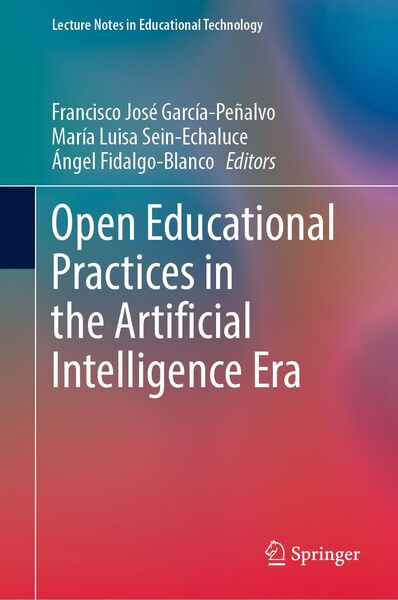
  • Produktbild: Open Educational Practices in the Artificial Intelligence Era
  • Produktbild: Open Educational Practices in the Artificial Intelligence Era

Open Educational Practices in the Artificial Intelligence Era

171,99 €

inkl. gesetzl. MwSt., Versandkostenfrei


Beschreibung

This book delves into the dynamic relationship between open education and artificial intelligence (AI), providing a comprehensive and interdisciplinary exploration of how AI transforms educational models and practices. The book brings together scholars, practitioners, and policymakers in the fields of...

Beschreibung

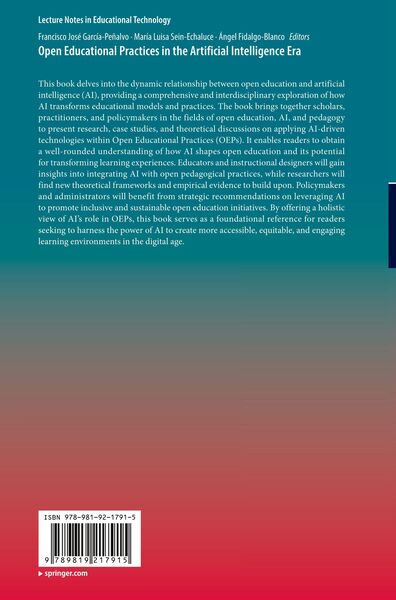
This book delves into the dynamic relationship between open education and artificial intelligence (AI), providing a comprehensive and interdisciplinary exploration of how AI transforms educational models and practices. The book brings together scholars, practitioners, and policymakers in the fields of open education, AI, and pedagogy to present research, case studies, and theoretical discussions on applying AI-driven technologies within Open Educational Practices (OEPs). It enables readers to obtain a well-rounded understanding of how AI shapes open education and its potential for transforming learning experiences. Educators and instructional designers will gain insights into integrating AI with open pedagogical practices, while researchers will find new theoretical frameworks and empirical evidence to build upon. Policymakers and administrators will benefit from strategic recommendations on leveraging AI to promote inclusive and sustainable open education initiatives. By offering a holistic view of AI’s role in OEPs, this book serves as a foundational reference for readers seeking to harness the power of AI to create more accessible, equitable, and engaging learning environments in the digital age.

Portrait

Francisco José García-Peñalvo is a Professor in the Department of Computer Science and Automation at the University of Salamanca (USAL), Spain, with four six-year periods of research, one six-year period of transferring and innovation, and five five-year periods of recognized teaching. Professor García-Peñalvo received the Gloria Begué award for teaching excellence in 2019 and the Maria de Maeztu award for research excellence in 2023. He was Distinguished Professor at the School of Humanities and Education at the Tecnológico de Monterrey, Mexico (2016-2018), and is Researcher of International Impact at the Universidad Nacional San Agustín, Arequipa, Peru. Since 2006, he has been Head of the Research Group Recognized by the USAL GRIAL (The research GRoup of InterAction and e-Learning). He is currently Deputy Director of the Research Institute for Educational Sciences, Rector's Delegate for Digital Learning and Teaching, and Coordinator of the Doctorate Program in Education in the Knowledge Society at USAL. He is Editor-in-Chief of the journals Education in the Knowledge Society and Journal of the Information Technology Research, and Associate Editor of many other journals, such as IEEE Transactions on Learning Technologies , IEEE Access , Computers in Human Behavior , and Computers in Human Behavior Reports . He has also published more than 150 research papers in journals.

María Luisa Sein-Echaluce obtained her Ph.D. in Mathematics, and is an Associate Professor of Applied Mathematics at the School of Engineering and Architecture in the University of Zaragoza, Spain, with three six-year periods of research and six five-year periods of recognized teaching. She was Director of the Virtual Campus of the University of Zaragoza from 2012 to 2020, and has been President of the Scientific Committee and Secretary of the Organization Committee in the 'International Conference on Learning, Innovation and Cooperation' (CINAIC) since 2011. She has extensive experience in the evaluation of educational research and innovation projects in several Spanish universities, as well as in the organization and implementation of permanent training courses on educational innovation and technologies. She has been Associate Editor for the special issues of some international research journals such as Computers in Human Behavior and European Journal of Engineering Education . She is also a member of numerous scientific committees of international journals and conferences and an author of multiple research papers published in journals.

Ángel Fidalgo-Blanco obtained his Ph.D. in Computer Science and Artificial Intelligence, and is Associate Professor and Director of the Laboratory for Innovation in Information Technologies at the Technical University of Madrid, Spain, with two six-year periods of research, one six-year period of transferring and innovation, and six five-year periods of recognized teaching. He was Deputy Director of the Applied Mathematics and Computer Methods department from 1999 to 2014. He received the award of 'Best OCW Subject Award' (OCW: OpenCourseWare) from the Ministry of Education of the Spanish Government and the 'Educational Innovation Award' and 'Teaching Excellence Award' from the Technical University of Madrid. He is currently President of the Organizing Committee for the International Conference of Learning, Innovation and Cooperation (CINAIC). He has been Associate Editor for special issues of some international research journals, is a member of numerous scientific committees for international journals and conferences, and an author of some research papers published in journals.


Produktdetails

Einband

Gebundene Ausgabe

Erscheinungsdatum

15.08.2026

Abbildungen

XIII, 238 p. 45 illus.

Herausgeber Francisco José García-Peñalvo + weitere

Produktdetails

Einband

Gebundene Ausgabe

Erscheinungsdatum

15.08.2026

Abbildungen

XIII, 238 p. 45 illus.

Herausgeber
Verlag Springer Singapore
Seitenzahl

238

Maße (L/B/H)

24,1/16/2 cm

Gewicht

495 g

Sprache

Englisch

ISBN

978-981-9217-91-5

Herstelleradresse

Springer-Verlag GmbH
Europaplatz 3
69115 Heidelberg
DE

Email: ProductSafety@springernature.com

Ein neues Kapitel für Ihre Bücher

Ein neues Kapitel für Ihre Bücher

Schenken Sie Ihren alten Schätzen ein zweites Leben und erhalten Sie dafür eine Thalia Geschenkkarte.

Jetzt verkaufen
Jetzt verkaufen

Noch keine Bewertungen vorhanden

Verfassen Sie die erste Bewertung zu diesem Artikel

Helfen Sie anderen Kundinnen und Kunden durch Ihre Meinung.

Kundinnen und Kunden meinen

Bewertungen (0)

Weitere Artikel finden Sie in

  • Produktbild: Open Educational Practices in the Artificial Intelligence Era
  • Produktbild: Open Educational Practices in the Artificial Intelligence Era
  • Chapter 01. Artificial intelligence in the future of education.- Chapter 02. One year of Artificial Intelligence disruption. Preuniversity teacher adoption and evolution.- Chapter 03. Exploring Data-Driven and Human-Centered Methodologies in Engineering Education: A Preliminary Validation Framework.- Chapter 04. Improving Course Design Through LLM-Assisted Educational Process Mining. Chapter 05. AI-Assisted Continuous Assessment in Programming Education: Design and Evaluation.- Chapter 06. Building an intelligent ecosystem for open educational resources: from discovery to personalized learning.- Chapter 07. Iterative Development and Validation of Rubrics for Assessing Educational Robotics Projects.- Chapter 08. Using generative artificial intelligence to conduct a problem-solving workshop.- Chapter 09. Pedagogical innovation in teaching data analysis in engineering through project-based collaborative learning and design thinking.- Chapter 10. Trustworthy and Open Educational Practices with AI: Small Language Models for Digital Sovereignty in Higher Education.- Chapter 11. Designing ethical AI companions for software engineering education: Lessons from a supervised chatbot for UML learning.- Chapter 12. Cocreation and evaluation in the era of Generative Artificial Intelligence tools: Learning experience revisited.- Chapter 13. An Academic Resource Development Experience through Service Learning Supported by Artificial Intelligence Tools for Identifying Earthquake Damage on Buildings.- Chapter 14. UniversiActuality: Artificial Intelligence as an Effective Tool Against Journalism Students’ Disinterest in Current Affairs.- Chapter 15. Artificial Intelligence as a Pedagogical Tool: Student Experiences with Concept Mapping in Higher Education.- Chapter 16. Generative AI for Analyzing Real Teamwork Interactions and Identifying Socioemotional Competencies.- Chapter 17. Integrating Open Educational Resources, Active Learning, and Artificial Intelligence for Lifelong Learning in Engineering Education.- Chapter 18. Fine-tuning Large Language Models for Educational Applications: Use Cases, Architectures, and Techniques.