















































KI-Beratung Beta

Gutscheinbedingungen

Gültig bis 11.11.2026 | Gültig für Spielzeug, Filme, Musik, Software, Games, Geschenke & Trends, Schreibwaren, Hörbücher und Hörbuch-Downloads (außer Abo & Shelfies), gebrauchte Bücher, nicht preisgebundene Bücher und Kalender | Einlösbar unter thalia.de und in der Thalia App | Click & Collect nur mit Online-Zahlung (Paypal/Kreditkarte) vorab | Einzelne Artikel können ausgeschlossen sein | Nicht kombinierbar mit anderen Gutscheinen oder Preisaktionen | Nur einmal pro Einkauf einlösbar | Gutschein wird auf max. 500€ Bestellwert angerechnet | Keine Barauszahlung | Digitale Hörbücher nur für Android  | Nicht gültig für preisgebundene Artikel (aufgrund der Buchpreisbindung sind Gutscheine nicht auf Bücher, eBooks, Presse einlösbar), tolino eReader & Zubehör, Abonnements & Flatrates, Geschenkkarten, Versandkosten und Services

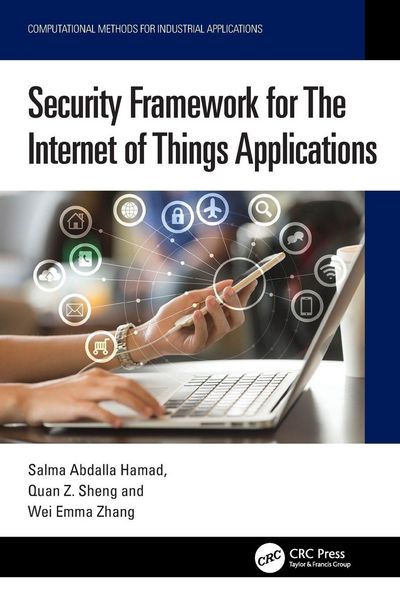
Produktbild: Security Framework for The Internet of Things Applications

Security Framework for The Internet of Things Applications

74,99 €

inkl. gesetzl. MwSt., Versandkostenfrei


Beschreibung

The text highlights a comprehensive survey that focuses on all security aspects and challenges facing the Internet of Things systems, including outsourcing techniques for partial computations on edge or cloud while presenting case studies to map security challenges. It further covers three security...

Beschreibung

The text highlights a comprehensive survey that focuses on all security aspects and challenges facing the Internet of Things systems, including outsourcing techniques for partial computations on edge or cloud while presenting case studies to map security challenges. It further covers three security aspects including Internet of Things device identification and authentication, network traffic intrusion detection, and executable malware files detection.

This book:


  • Presents a security framework model design named Behavioral Network Traffic Identification and Novelty Anomaly Detection for the IoT Infrastructures

  • Highlights recent advancements in machine learning, deep learning, and networking standards to boost Internet of Things security

  • Builds a near real-time solution for identifying Internet of Things devices connecting to a network using their network traffic traces and providing them with sufficient access privileges

  • Develops a robust framework for detecting IoT anomalous network traffic

  • Covers an anti-malware solution for detecting malware targeting embedded devices

It will serve as an ideal text for senior undergraduate and graduate students, and professionals in the fields of electrical engineering, electronics and communication engineering, computer engineering, and information technology.

Produktdetails

Einband

Taschenbuch

Erscheinungsdatum

22.06.2026

Abbildungen

schwarz-weiss Illustrationen, Raster,schwarz-weiss, Zeichnungen, schwarz-weiss, Tabellen, schwarz-weiss

Verlag Taylor and Francis

Produktdetails

Einband

Taschenbuch

Erscheinungsdatum

22.06.2026

Abbildungen

schwarz-weiss Illustrationen, Raster,schwarz-weiss, Zeichnungen, schwarz-weiss, Tabellen, schwarz-weiss

Verlag Taylor and Francis
Seitenzahl

134

Maße (L/B/H)

23,4/15,6/0,8 cm

Gewicht

227 g

Sprache

Englisch

ISBN

978-1-03-276489-4

Herstelleradresse

Libri GmbH
Europaallee 1
36244 Bad Hersfeld
DE

Email: gpsr@libri.de

Ein neues Kapitel für Ihre Bücher

Ein neues Kapitel für Ihre Bücher

Schenken Sie Ihren alten Schätzen ein zweites Leben und erhalten Sie dafür eine Thalia Geschenkkarte.

Jetzt verkaufen
Jetzt verkaufen

Noch keine Bewertungen vorhanden

Verfassen Sie die erste Bewertung zu diesem Artikel

Helfen Sie anderen Kundinnen und Kunden durch Ihre Meinung.

Kundinnen und Kunden meinen

Bewertungen (0)

Die Leseprobe wird geladen.
  • Produktbild: Security Framework for The Internet of Things Applications
  • 1. Introduction 2. Background and the State-Of-The-Art Security Solutions. 3. IoT Device Identification and Finger-printing. 4. Behavioural Novelty Detection for IoT Network Traffic. 5. Detection of Malware Targeting Embedded Devices. 6. Conclusion and Future Directions References