















































KI-Beratung Beta

  • Produktbild: Higher Education Learning Methodologies and Technologies Online
  • Produktbild: Higher Education Learning Methodologies and Technologies Online
Band 2959

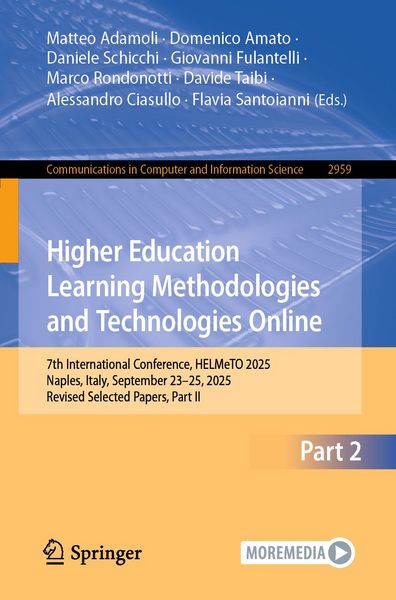
Higher Education Learning Methodologies and Technologies Online 7th International Conference, HELMeTO 2025, Naples, Italy, September 23–25, 2025, Revised Selected Papers, Part II

96,99 €

inkl. gesetzl. MwSt., Versandkostenfrei


Beschreibung

Produktdetails

Einband

Taschenbuch

Erscheinungsdatum

16.08.2026

Abbildungen

XXI, 426 p. 78 illus., 43 illus. in color.

Herausgeber

Matteo Adamoli + weitere

Verlag

Springer

Seitenzahl

426

Maße (L/B/H)

23,5/15,5/2,5 cm

Gewicht

674 g

Sprache

Englisch

ISBN

978-3-032-31852-7

Beschreibung

Produktdetails

Einband

Taschenbuch

Erscheinungsdatum

16.08.2026

Abbildungen

XXI, 426 p. 78 illus., 43 illus. in color.

Herausgeber

Verlag

Springer

Seitenzahl

426

Maße (L/B/H)

23,5/15,5/2,5 cm

Gewicht

674 g

Sprache

Englisch

ISBN

978-3-032-31852-7

Herstelleradresse

Springer-Verlag KG
Sachsenplatz 4-6
1201 Wien
AT

Email: ProductSafety@springernature.com

Ein neues Kapitel für Ihre Bücher

Ein neues Kapitel für Ihre Bücher

Schenken Sie Ihren alten Schätzen ein zweites Leben und erhalten Sie dafür eine Thalia Geschenkkarte.

Jetzt verkaufen
Jetzt verkaufen

Noch keine Bewertungen vorhanden

Verfassen Sie die erste Bewertung zu diesem Artikel

Helfen Sie anderen Kundinnen und Kunden durch Ihre Meinung.

Kundinnen und Kunden meinen

Bewertungen (0)

  • Produktbild: Higher Education Learning Methodologies and Technologies Online
  • Produktbild: Higher Education Learning Methodologies and Technologies Online
  • .- Artificial Intelligence in Education.

    .- Integrating DESMOS as a Pedagogical Tool in Primary School Mathematics Education.

    .- AI-based eSports into Youth Football Training: a Hybrid Approach to Motor Learning.

    .- Mapping Artificial Intelligence in Higher Education: Educational Challenges and Opportunities – A Scoping Review.

    .- Artificial Intelligence in Academia: A Systematic Review of Faculty Implications Across Design and Practice.

    .- Modeling Teacher-AI Interactions Through Covariational Instructions in the Mathematical Working Space.

    .- Digital and face-to-face learning environments for university mathematics education: objectification and subjectification in communities of practice mediated by the Quick Chat plugin.

    .- A Research Design for the Integration of Large Language Models and Advanced Computing Environments in Mathematical Problem Solving.

    .- Artificial Intelligence as a Reflective Symbolic Space: Educational Perspectives on Adolescent Emotional Support .

    .- Personalised Physical Exercise supported by an AI-based virtual assistant.

    .- Empowering Teachers Digital Professional Practices: Findings from a Practice-Based Training Experience.

    .- Active Online Assessment in Higher Education: Integrating Generative AI into Formative and Summative Evaluation.

    .- Using Customized Generative Chatbots to Structure Physical Education Didactics: The UniVersus project.

    .- Evaluating AI-Generated Mathematical Reasoning in University Education: ChatGPT and Logical Implication.

    .- Bridging Learning and Employability: The Evolving Role of Teaching, Technology, and Faculty Development in Business Schools.

    .- AI Literacy.

    .- Teaching with AI for Inclusion: A Socratic Approach.

    .- Integrating ChatGPT into Student Research Practices.

    .- AI Literacy and Integration in Socio-educational Contexts: The TEACH-AI Project.

    .- Personalized Pathways: Adaptive AI Assistants in the Primary Classroom.

    .- Mathematics Education in the Age of GenAI: rethinking “learning by making” through “learning by prompting” .

    .- Exploring Metacognition in Math with Generative AI: A Pilot Study of the MAI-C in Higher Education.

    .- Exploring Students’ Engagement in Youth-Led Participa-tory Action on Research Digital Technologies and Re-sponsible Artificial Intelligence.

    .- Cognitive Entanglements: A Postphenomenological Approach to Generative AI in Education.

    .- When Pedagogical and Medical Care Meet Through Artificial Intelligence: A ChatGPT-Based Training Proposal for Medical Students.

    .- Impact of the “Elements of AI” Course on Students' AI Literacy and Critical Thinking .

    .- Toward an AI learning environment: Vygotskian scaffolding approaches to generative artificial intelligence.

    .- Exploring AI in Socio-Educational Practices: A New Theoretical Framework.

    .- A Human-in-the-Loop Framework for AI-Assisted MOOC Production: Managing GenAI Risks in Educational Content Production.