















































KI-Beratung Beta

Produktbild: Prospects of Fungal Biotechnologies for Livestock Volume 3
Vorbesteller Neu

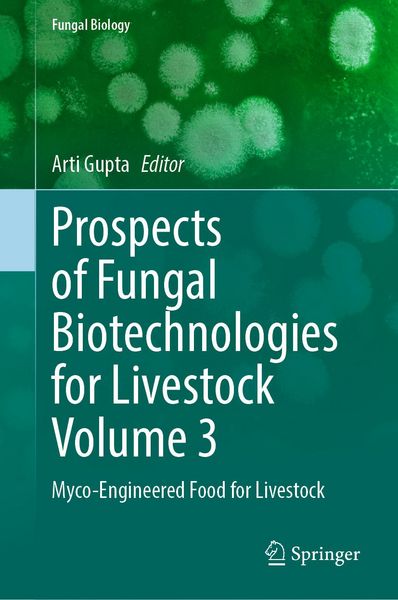
Prospects of Fungal Biotechnologies for Livestock Volume 3 Myco-Engineered Food for Livestock

Aus der Reihe Fungal Biology

213,99 €

inkl. gesetzl. MwSt., Versandkostenfrei


Beschreibung

Produktdetails

Einband

Gebundene Ausgabe

Erscheinungsdatum

26.11.2026

Abbildungen

X, 339 p. 34 illus., 32 illus. in color.

Herausgeber

Arti Gupta

Verlag

Springer

Seitenzahl

339

Maße (B/H)

15,5/23,5 cm

Sprache

Englisch

ISBN

978-3-032-33285-1

Beschreibung

Portrait

Dr. Arti Gupta is an Assistant Professor in Department of Biology, Sri Avadh Raj Singh Smarak Degree College, Bishunpur Bairiya, Gonda, India. Dr. Arti received her B.Sc. (CBZ) and M.Sc. in Biotechnology from Chaudhary Charan Singh University, Meerut, India. Dr. Gupta obtained her Ph.D. from Mahatma Jyotiba Phule Rohilkhand University, Bareilly, India. Dr. Gupta’s current research interests are Animal Biotechnology, Molecular Plant Biotechnology, Molecular Animal Biotechnology, Bioprocess Technology, and Microbiology. Dr. gupta has published 2 monographs, 26 edited books with Springer Nature, Switzerland, CRC Press T&Y USA, De Gruyter and GmBH Germany; 21 book chapters, and around 55 National and International research papers.  Dr. Gupta has been awarded with Gold Medal, M.Sc. (Biotech.), Young Scientist Award, 2 Poster Presenter awards, Fellowship Award awarded by International Consortium of Contemporary Biologist and Dr. V.P. Agarwal Gold Medal awarded. Dr. Arti has a lifetime membership of Indian Science Congress Association, Biotech Research Society of India, Zoological Society of India and International Consortium of Contemporary Biologist.

Produktdetails

Einband

Gebundene Ausgabe

Erscheinungsdatum

26.11.2026

Abbildungen

X, 339 p. 34 illus., 32 illus. in color.

Herausgeber

Arti Gupta

Verlag

Springer

Seitenzahl

339

Maße (B/H)

15,5/23,5 cm

Sprache

Englisch

ISBN

978-3-032-33285-1

Herstelleradresse

Springer Nature Customer Service Center GmbH
Europaplatz 3
69115 Heidelberg
DE
ProductSafety@springernature.com

Ein neues Kapitel für Ihre Bücher

Ein neues Kapitel für Ihre Bücher

Schenken Sie Ihren alten Schätzen ein zweites Leben und erhalten Sie dafür eine Thalia Geschenkkarte.

Jetzt verkaufen
Jetzt verkaufen

Noch keine Bewertungen vorhanden

Verfassen Sie die erste Bewertung zu diesem Artikel

Helfen Sie anderen Kundinnen und Kunden durch Ihre Meinung.

Kundinnen und Kunden meinen

Bewertungen (0)

  • Produktbild: Prospects of Fungal Biotechnologies for Livestock Volume 3
  • 1. Introduction to Fungal Applications in Livestock: Overview of fungal applications in livestock, Importance and benefits.- 2.  Fungal Applications in Poultry: Specific fungi used, Benefits and case studies.- 3. Fungal Applications in Cattle: Use of fungi in tick control, Impact on cattle health and productivity.- 4. Fungal Applications in Other Livestock: Applications in sheep, goats, etc., Comparative benefits.- 5. Fungal Biotechnology in Animal Feed: Use of fungi in enhancing feed quality, Case studies and research findings.- 6. Fungal Applications in Animal Health: Role of fungi in disease prevention and treatment, Specific examples and studies.- 7. Environmental Impact of Fungal Applications: Sustainability and ecological benefits, Case studies on environmental impact.- 8. Future Prospects and Innovations: Emerging trends and technologies, Potential future applications.- 9. Filamentous Fungi: Exploration of filamentous fungi for functional food and feed applications.- 10. Nanomedicinal Approaches: Innovative treatments for fungal livestock diseases using nanotechnology. Fungi causing sporotrichosis, histoplasmosis and Histoplasma.- 11. Enhanced Protein Content and Quality: Fungal fermentation can increase the protein content of agricultural side streams.- 12. Improved Digestibility: The fermentation process breaks down complex carbohydrates and fibers, making the nutrients more accessible and easier to digest for animals.- 13. Sustainability: Utilizing agricultural by-products reduces waste and provides a sustainable source of high-quality protein.- 14. Nutritional Enrichment: Besides proteins, the fermented products can be enriched with essential amino acids, vitamins (like Vitamin D2), and other beneficial compounds.