















































KI-Beratung Beta

Gutscheinbedingungen

Gültig bis 11.11.2026 | Gültig für Spielzeug, Filme, Musik, Software, Games, Geschenke & Trends, Schreibwaren, Hörbücher und Hörbuch-Downloads (außer Abo & Shelfies), gebrauchte Bücher, nicht preisgebundene Bücher und Kalender | Einlösbar unter thalia.de und in der Thalia App | Click & Collect nur mit Online-Zahlung (Paypal/Kreditkarte) vorab | Einzelne Artikel können ausgeschlossen sein | Nicht kombinierbar mit anderen Gutscheinen oder Preisaktionen | Nur einmal pro Einkauf einlösbar | Gutschein wird auf max. 500€ Bestellwert angerechnet | Keine Barauszahlung | Digitale Hörbücher nur für Android  | Nicht gültig für preisgebundene Artikel (aufgrund der Buchpreisbindung sind Gutscheine nicht auf Bücher, eBooks, Presse einlösbar), tolino eReader & Zubehör, Abonnements & Flatrates, Geschenkkarten, Versandkosten und Services

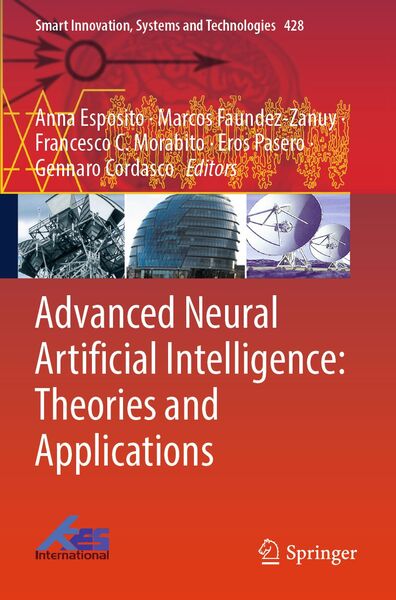
Produktbild: Advanced Neural Artificial Intelligence: Theories and Applications

Advanced Neural Artificial Intelligence: Theories and Applications

235,99 €

inkl. gesetzl. MwSt., Versandkostenfrei


Beschreibung

Produktdetails

Einband

Taschenbuch

Erscheinungsdatum

25.05.2026

Abbildungen

XXVIII, 479 p. 126 illus., 104 illus. in color.

Herausgeber

Anna Esposito + weitere

Verlag

Springer Singapore

Seitenzahl

479

Maße (L/B/H)

23,5/15,5/2,8 cm

Gewicht

762 g

Sprache

Englisch

ISBN

978-981-9609-96-3

Beschreibung

Portrait


Anna Esposito received her
Laurea Degree
summa cum laude in Information Technology and Computer Science from Salerno University (1989), and the PhD Degree in Applied Mathematics and Computer Science from Napoli University
Federico II
(1995) with a thesis developed at MIT, Boston, USA. She was a postdoc at the International Institute for Advanced Scientific Studies (IIASS), lecturer at Salerno University Dep of Physics (1996–2000), and research professor  (2000–2002) at Wright State University (WSU), Department of Computer Science and Engineering, OHIO, USA. She is a full professor in Cybernetics, Artificial Intelligence, and Multimodal Communication at Università della Campania “Luigi Vanvitelli,” codirecting the activities of the Behavioral Cognitive Systems (BeCogSys) research group. She is an author/coauthor of 300+ peer-reviewed publications in journals, books, and conference proceedings, editor/co-editor of 32+ international books, and PI/CoPI of 10+ national and international funded projects.


Marcos Faundez-Zanuy received the B.Sc. degree (1993) and the Ph.D. degree (1998), both from the Polytechnic University of Catalunya. He is a full professor at ESUP Tecnocampus Mataro and heads the Signal Processing Group. His research interests lie in biometrics applied to security and health. He was the initiator and chairman of the EU COST Action 277 “Nonlinear Speech Processing,” and secretary of COST Action 2102 “Cross-Modal Analysis of Verbal and Non-Verbal Communication.” He is an author of 50+ papers indexed in ISI Journal citation reports, 100+ conference papers, 10+ books, and PI of 10 national and EU funded projects.


Francesco Carlo Morabito joined the University of Reggio Calabria, Italy, in 1989 where he serves now as a full professor (2001) of Electrical Engineering. He served as the president of the Electronic Engineering Course, as a member of the University’s Inner Evaluation Committee, as the dean of the Faculty of Engineering, as a deputy rector, and serves now as a vice-rector for Internationalization. He is a member of the Steering Committee of the Italian Society of Electrical Engineering.


Eros G. Pasero is a professor of Electronics at Polytechnic of Turin since 1991. He was a visiting professor at ICSI Berkeley (1991), Tongji University Shanghai (2011, 2015), and Tashkent Polytechnic University, Uzbekistan. His interests are in artificial neural networks and electronic sensors. He heads the Neuronica Lab (1990) where wired and wireless sensors are developed for biomedical, environmental, automotive applications, and sensor signals are processed by neural networks. Prof. Pasero is the president of the Italian Society for Neural Networks (SIREN) and was a general chair of IJCNN2000, SIRWEC2006, and WIRN 2015. He received several awards and holds five international patents. He supervised 10 international Ph.D. and 100 Master theses and is an author of 100+ international publications.


Gennaro Cordasco received the Laurea degree summa cum laude (in 2002) and the Ph.D. degree in Computer Science (2006) from the University of Salerno (Italy). He has been a research-scholar at the Theoretical Aspect of Parallel and Distributed Systems (TAPADS) Lab, in the Department of Computer Science, University of Massachusetts at Amherst MA, USA, doing research activity under the supervision of the Distinguished Professor Arnold L. Rosenberg (From March to November 2005). Gennaro Cordasco is an associate professor at the Università della Campania "Luigi Vanvitelli" (Italy) and member of the editorial board of COGNITIVE COMPUTATION and  Journal of Ambient Intelligence and Humanized Computing. He is codirecting the activities of the Behavioral Cognitive Systems (BeCogSys) research group.

Produktdetails

Einband

Taschenbuch

Erscheinungsdatum

25.05.2026

Abbildungen

XXVIII, 479 p. 126 illus., 104 illus. in color.

Herausgeber

Verlag

Springer Singapore

Seitenzahl

479

Maße (L/B/H)

23,5/15,5/2,8 cm

Gewicht

762 g

Sprache

Englisch

ISBN

978-981-9609-96-3

Herstelleradresse

Springer-Verlag KG
Sachsenplatz 4-6
1201 Wien
AT

Email: ProductSafety@springernature.com

Ein neues Kapitel für Ihre Bücher

Ein neues Kapitel für Ihre Bücher

Schenken Sie Ihren alten Schätzen ein zweites Leben und erhalten Sie dafür eine Thalia Geschenkkarte.

Jetzt verkaufen
Jetzt verkaufen

Noch keine Bewertungen vorhanden

Verfassen Sie die erste Bewertung zu diesem Artikel

Helfen Sie anderen Kundinnen und Kunden durch Ihre Meinung.

Kundinnen und Kunden meinen

Bewertungen (0)

  • Produktbild: Advanced Neural Artificial Intelligence: Theories and Applications

  • A Preliminary Evaluation of Machine Learning Models for the Diagnosis of Brugada Syndrome from ECG-Extracted Features.- ECG Images Analysis for the Prediction of Fatal Arrhythmic Events in Patients with Brugada Syndrome based on a Vision Transformer Model.- Enhancing ECG Analysis with a Hybrid Deep Learning Approach: Automatic Detection of Significant Features.- Virtual Mines – Component-Level Recycling of Printed Circuit Boards using Deep Learning.- Comparison of LSTM-based models for the 6-Hour-Ahead and Day-Ahead Forecasting of Photovoltaic Power Generation .- Forward Approximate Solution for Linear Quadratic Tracking .- Deep Echo State Network for Environmental Sound Classification.- A Fuzzy Logic Approach for Pandemic Risk Assessment and Restrictions Design.- Multi-Objective Multi-Layer Perceptron Architecture Optimization for Rapid Post-Earthquake Damage Evaluation.- Uncertainty Estimation Via Ensembles of Deep Learning  Models and Dropout Layers for Seismic Traces.