















































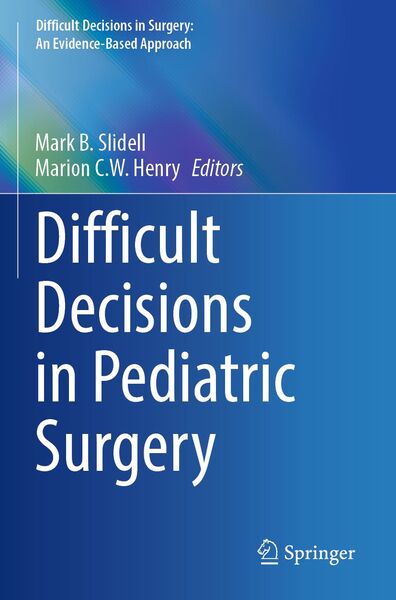
Difficult Decisions in Pediatric Surgery
-
- Hardcover
- Taschenbuch ausgewählt
- eBook
-
Sprache:Englisch
149,99 €
inkl. gesetzl. MwSt.,
Beschreibung
Produktdetails
Einband
Taschenbuch
Erscheinungsdatum
29.03.2026
Abbildungen
VIII, 584 p. 16 illus., 12 illus. in color.
Herausgeber
Mark B. Slidell + weitereVerlag
SpringerSeitenzahl
584
Maße (L/B/H)
23,5/15,5/3,2 cm
Gewicht
885 g
Sprache
Englisch
ISBN
978-3-031-80470-0
Pediatric surgery is a demanding specialty that requires not only technical expertise but also exceptional clinical judgment and adaptability. Pediatric surgeons frequently encounter rare congenital anomalies and unusual surgical problems, often requiring them to make difficult decisions with limited precedent. Even well-recognized congenital conditions can present in atypical ways, necessitating a patient-centered approach that may deviate from routine practice. This places a premium on a surgeon’s ability to apply broad surgical principles to novel and complex situations, tailoring interventions to each child’s unique anatomy and pathology. Compounding this challenge is the rapidly evolving literature in pediatric surgery, where new techniques, evolving guidelines, and emerging technologies continually reshape best practices. Thoughtful interpretation of the literature is essential, particularly when the optimal approach to a problem remains unclear or controversial. Pediatric surgeons must not only stay abreast of these developments but also critically analyze and synthesize data to make sound, evidence-based decisions in the face of uncertainty.
The Difficult Decisions in Surgery series was developed to address many of these challenges faced by surgeons. To date, 10 volumes have been published, receiving enthusiastic engagement from the surgical community. These multi-authored volumes consist of concise chapters, each focused on a specific difficult or controversial decision within a surgical specialty. This series is particularly well-suited for pediatric surgeons, as it provides insight into difficult decisions faced within the field.
The volumes serve as a timely reference for practicing surgeons, trainees, and educators, emphasizing the ideal approach to selected clinical situations rather than merely reflecting customary care. Recommendations are grounded in published evidence, while also incorporating expert opinions and personal experiences, helping surgeons navigate complex, evolving literature and apply general surgical principles to novel pediatric challenges.
The chapters in each volume adhere to a specific format. This approach provides uniformity to the presentations, making it possible to identify useful material at a glance:
- a brief general introduction and description of the Difficult Decision laid out using PICO formatting·
- a brief description of the literature search process.
- a summary of available published evidence and discussion of the findings.
- the author’s personal view of the data and approach to the problem and why they do (or don’t do) things found in the presented literature.
- the chapter authors were selected from experts around the world.
- the editors for this volume were selected from among internationally renown faculty at The University of Chicago and The Johns Hopkins University.
Ein neues Kapitel für Ihre Bücher
Ein neues Kapitel für Ihre Bücher
Schenken Sie Ihren alten Schätzen ein zweites Leben und erhalten Sie dafür eine Thalia Geschenkkarte.
Noch keine Bewertungen vorhanden
Verfassen Sie die erste Bewertung zu diesem Artikel
Helfen Sie anderen Kundinnen und Kunden durch Ihre Meinung.
Kurze Frage zu unserer Seite
Vielen Dank für Ihr Feedback
Wir nutzen Ihr Feedback, um unsere Produktseiten zu verbessern. Bitte haben Sie Verständnis, dass wir Ihnen keine Rückmeldung geben können. Falls Sie Kontakt mit uns aufnehmen möchten, können Sie sich aber gerne an unseren Kund*innenservice wenden.
zum Kundenservice