















































KI-Beratung Beta

Gutscheinbedingungen

Gültig bis 11.11.2026 | Gültig für Spielzeug, Filme, Musik, Software, Games, Geschenke & Trends, Schreibwaren, Hörbücher und Hörbuch-Downloads (außer Abo & Shelfies), gebrauchte Bücher, nicht preisgebundene Bücher und Kalender | Einlösbar unter thalia.de und in der Thalia App | Click & Collect nur mit Online-Zahlung (Paypal/Kreditkarte) vorab | Einzelne Artikel können ausgeschlossen sein | Nicht kombinierbar mit anderen Gutscheinen oder Preisaktionen | Nur einmal pro Einkauf einlösbar | Gutschein wird auf max. 500€ Bestellwert angerechnet | Keine Barauszahlung | Digitale Hörbücher nur für Android  | Nicht gültig für preisgebundene Artikel (aufgrund der Buchpreisbindung sind Gutscheine nicht auf Bücher, eBooks, Presse einlösbar), tolino eReader & Zubehör, Abonnements & Flatrates, Geschenkkarten, Versandkosten und Services

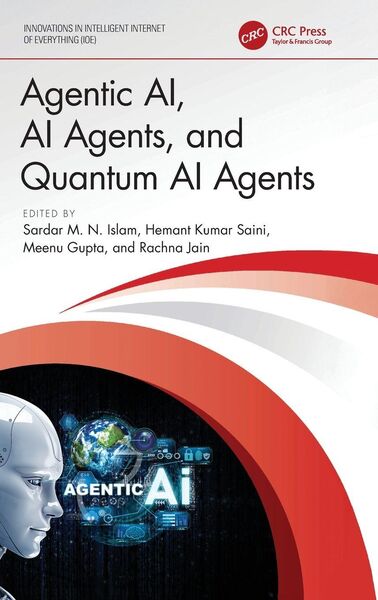
Produktbild: Agentic AI, AI Agents, and Quantum AI Agents
Vorbesteller Neu

Agentic AI, AI Agents, and Quantum AI Agents

219,99 €

inkl. gesetzl. MwSt., Versandkostenfrei


Beschreibung

Produktdetails

Einband

Gebundene Ausgabe

Erscheinungsdatum

15.12.2026

Abbildungen

schwarz-weiss Illustrationen, Raster,schwarz-weiss, Zeichnungen, schwarz-weiss, Tabellen, schwarz-weiss

Herausgeber

Sardar M. N. Islam + weitere

Verlag

Taylor and Francis

Seitenzahl

366

Maße (L/B)

23,4/15,6 cm

Sprache

Englisch

ISBN

978-1-04-127303-5

Beschreibung

Portrait

Sardar M. N. Islam (Naz) is a Research Professor at Victoria University, Australia. He is also a Distinguished Visiting Professor of Artificial Intelligence and a Distinguished Visiting Professor at the American University of Ras Al Khaimah (AURAK) from 2019 to 2021, an Adjunct Professor of Information Technology and Business at Armstrong Institute, Melbourne, Australia, and Editor-in-Chief of International Transactions on Artificial Intelligence. His academic work has gained international acclaim, resulting in considerable honours and awards, many visiting or adjunct professorial appointments in different countries, many appointments in editorial roles of journals, and a large number of keynote speeches at international conferences in several countries.

Hemant Kumar Saini is an Assistant Professor at Bennett University. He completed his postdoctoral work at Lincoln University College Malaysia and earned a PhD in ad hoc networks and an MTech (Gold Medalist) in computer science engineering. He is a Red Hat Certified Engineer. Additionally, he has served as a keynote speaker and resource person for several workshops and webinars conducted in India. His research includes digital transformation technologies such as artificial intelligence (AI), quantum computing, the Internet of Things (IoT), blockchain, edge and serverless computing.

Meenu Gupta is a Professor, Associate Dean of Research and Outreach, Head of the School of Computer Science and Engineering, Geeta University, Panipat, India. She completed her postdoctural fellowship at MIR Labs, USA, and earned a PhD in computer science and engineering from Ansal University, Gurgaon (2020). Her research areas cover machine learning, intelligent systems, and data mining, with a specific interest in artificial intelligence, image processing and analysis, smart cities, data analysis, and brain-machine interface (BMI).

Rachna Jain is an Associate Professor at Bhagwan Parsuram Institute of Technology (GGSIPU). She worked as an Assistant Professor in the Computer Science Department at Bharati Vidyapeeth's College of Engineering, Guru Gobind Singh Indraprastha University (GGSIPU), New Delhi, India, from August 2007 to August 2021. She earned a PhD from Banasthali Vidyapith, Radha Kishnpura, India, in computer science in 2017. She earned an ME degree in 2011 from Delhi College of Engineering (Delhi University), New Delhi, India, with a specialization in computer technology and applications. Her research interests include cloud computing, fuzzy logic, network and information security, swarm intelligence, big data and IoT, deep learning, and machine learning. She is listed among the top 2% of scientists according to Stanford University rankings in 2022 and 2023.

Produktdetails

Einband

Gebundene Ausgabe

Erscheinungsdatum

15.12.2026

Abbildungen

schwarz-weiss Illustrationen, Raster,schwarz-weiss, Zeichnungen, schwarz-weiss, Tabellen, schwarz-weiss

Herausgeber

Verlag

Taylor and Francis

Seitenzahl

366

Maße (L/B)

23,4/15,6 cm

Sprache

Englisch

ISBN

978-1-04-127303-5

Herstelleradresse

Libri GmbH
Europaallee 1
36244 Bad Hersfeld
DE

Email: gpsr@libri.de

Ein neues Kapitel für Ihre Bücher

Ein neues Kapitel für Ihre Bücher

Schenken Sie Ihren alten Schätzen ein zweites Leben und erhalten Sie dafür eine Thalia Geschenkkarte.

Jetzt verkaufen
Jetzt verkaufen

Noch keine Bewertungen vorhanden

Verfassen Sie die erste Bewertung zu diesem Artikel

Helfen Sie anderen Kundinnen und Kunden durch Ihre Meinung.

Kundinnen und Kunden meinen

Bewertungen (0)

Die Leseprobe wird geladen.
  • Produktbild: Agentic AI, AI Agents, and Quantum AI Agents
  • Part I: Foundations of Agentic AI and Intelligent Agents. 1. Introduction to Agentic AI, AI Agents, and Autonomous Systems. 2. Fundamentals of Agent Architectures and Behaviors. 3. AI Agent Planning, Learning, and Adaptation. 4. Reinforcement Learning and Deep Multi¿Agent Systems. Part II: Engineering, Deployment, and Responsible Agentic AI. 5. Developing AI Agents Using Python and Agent Platforms (e.g., Spade, Jade). 6. Simulation and Deployment of Multi¿Agent Systems in Real¿World Environments. 7. Secure, Ethical, and Explainable AI Agents. 8. Case Studies in Robotics, Finance, and Cybersecurity. Part III: Quantum AI Agents: Foundations, Intelligence, and Applications. 9. Introduction to Quantum Computing for AI Agents. 10. Exploring Quantum Machine Learning Frameworks. 11. Quantum Machine Learning for Autonomous Agents. 12. Quantum Game Theory and Quantum Decision Systems. 13. Quantum Computing as a Catalyst for Agentic AI. 14. Quantum AI Agents in Smart Cities, Healthcare, and Logistics. 15. Ethical, Social, and Governance Issues in Quantum Agent Systems.