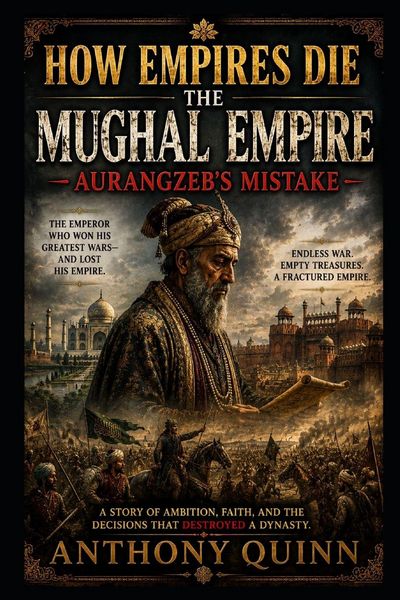
How Empires Die The Mughal Empire - Aurangzeb's Mistake
-
- Englisch ausgewählt
13,99 €
inkl. gesetzl. MwSt.,
Beschreibung
Produktdetails
Einband
Taschenbuch
Erscheinungsdatum
26.06.2026
Verlag
Independently PublishedSeitenzahl
178
Maße (L/B/H)
22,9/15,2/1 cm
Gewicht
248 g
Sprache
Englisch
EAN
9798184373003
How Empires Die: The Mughal Empire - Aurangzeb's Mistake
At its peak, the Mughal Empire was one of the richest and most sophisticated empires on Earth.
Its rulers commanded immense armies. Its treasuries overflowed. Its cities dazzled visitors with wealth beyond imagination. The empire built monuments so magnificent they still define civilization centuries later including Taj Mahal, perhaps the most famous monument on Earth. Under Shah Jahan, Mughal power seemed permanent.
Then one emperor made a decision that changed everything.
Not in a single battle.
Not in a dramatic invasion.
Not in one catastrophic year.
But through a series of choices that looked logical... even righteous... at the time.
That is the mistake most people never see coming.
In How Empires Die: The Mughal Empire - Aurangzeb's Mistake, Anthony Quinn reveals how Aurangzeb inherited a thriving superpower and slowly broke the political compact that had made it strong.
He believed he was saving the empire.
He believed stricter control would create order.
He believed religious discipline would strengthen legitimacy.
He believed endless military campaigns would secure the frontier.
Instead, he triggered forces he could no longer control.
As alliances fractured, provincial elites stopped cooperating. Revenue weakened. Wars drained the treasury. Trust evaporated. The imperial machine that had once turned wealth, culture, and diversity into power began consuming itself.
What you'll discover inside:
- Why the empire's greatest strength was also its hidden vulnerability
- The surprising reason wealth and grandeur can make collapse harder to see
- What Aurangzeb changed that instantly alarmed powerful allies
- Why empires often fail not from weakness but from overconfidence
- The hidden reason long wars destroy political loyalty before they empty treasuries
- How one policy decision can quietly unravel decades of stability
- Why the fall began long before anyone realized the empire was in danger
If you've ever seen a leader double down when flexibility was needed...
If you've watched institutions become rigid instead of adaptive...
If you've wondered how something powerful can suddenly become fragile...
You already understand the central tragedy of the Mughal Empire.
This is not just a story about India.
It is a timeless lesson in power.
Empires rarely die because they are too weak.
They die because their leaders stop understanding what made them strong.
Ein neues Kapitel für Ihre Bücher
Ein neues Kapitel für Ihre Bücher
Schenken Sie Ihren alten Schätzen ein zweites Leben und erhalten dafür eine Thalia Geschenkkarte.
Noch keine Bewertungen vorhanden
Verfassen Sie die erste Bewertung zu diesem Artikel
Helfen Sie anderen Kundinnen und Kunden durch Ihre Meinung.
Kurze Frage zu unserer Seite
Vielen Dank für Ihr Feedback
Wir nutzen Ihr Feedback, um unsere Produktseiten zu verbessern. Bitte haben Sie Verständnis, dass wir Ihnen keine Rückmeldung geben können. Falls Sie Kontakt mit uns aufnehmen möchten, können Sie sich aber gerne an unseren Kund*innenservice wenden.
zum Kundenservice