















































KI-Beratung Beta

Gutscheinbedingungen

Gültig bis 11.11.2026 | Gültig für Spielzeug, Filme, Musik, Software, Games, Geschenke & Trends, Schreibwaren, Hörbücher und Hörbuch-Downloads (außer Abo & Shelfies), gebrauchte Bücher, nicht preisgebundene Bücher und Kalender | Einlösbar unter thalia.de und in der Thalia App | Click & Collect nur mit Online-Zahlung (Paypal/Kreditkarte) vorab | Einzelne Artikel können ausgeschlossen sein | Nicht kombinierbar mit anderen Gutscheinen oder Preisaktionen | Nur einmal pro Einkauf einlösbar | Gutschein wird auf max. 500€ Bestellwert angerechnet | Keine Barauszahlung | Digitale Hörbücher nur für Android  | Nicht gültig für preisgebundene Artikel (aufgrund der Buchpreisbindung sind Gutscheine nicht auf Bücher, eBooks, Presse einlösbar), tolino eReader & Zubehör, Abonnements & Flatrates, Geschenkkarten, Versandkosten und Services

Produktbild: Gender-Just Family Laws and Feminist Engagements in South Asia
Neu

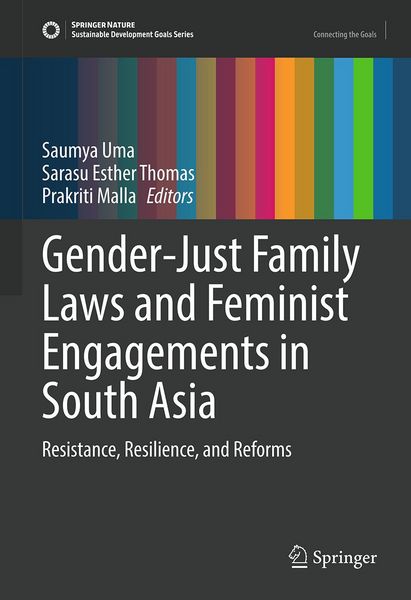
Gender-Just Family Laws and Feminist Engagements in South Asia Resistance, Resilience, and Reforms

181,99 €

inkl. gesetzl. MwSt., Versandkostenfrei


Beschreibung

Produktdetails

Einband

Gebundene Ausgabe

Erscheinungsdatum

28.10.2026

Abbildungen

XXXII, 316 p.

Herausgeber

Saumya Uma + weitere

Verlag

Springer Singapore

Seitenzahl

316

Maße (L/B)

25,4/17,8 cm

Sprache

Englisch

ISBN

978-981-9239-44-3

Beschreibung

Portrait

Saumya Uma is Professor and Dean of Faculty of Law, Manipal University Jaipur, India. She worked previously as Professor of Law and Director of Centre for Women’s Rights at Jindal Global Law School, O.P. Jindal Global University, India. She has over 32 years’ combined work experience as an academic, law researcher, law practitioner, trainer, writer and campaigner, working at the intersections of gender, law, and human rights. She has taught family law for over ten years and worked as a matrimonial law practitioner in Mumbai courts for several years prior to the same. She has published several articles on aspects of family law and gender justice. She has served as a research consultant with the UNDP, UNOHCHR and the International Commission of Jurists. Her latest monograph titled ‘Violence, Gender and the State’ was published in 2024. Dr. Uma is a life member of Indian Association for Women’s Studies (IAWS), member of Global Campaign for Equality in Family Law (GCEFL), among others. She is a member of the editorial advisory board of Indian Journal of Gender Studies .

Sarasu Esther Thomas is Professor and Director at Manipal Law School, Bangalore Campus, India. She has worked at the National Law School of India University (NLSIU) from her LLM days in 1996. She has held various leadership positions during her tenure with NLSIU, including the position of the Registrar of the University. She headed the Centre for Women and the Law and set up the Ford Foundation Human Rights Lawyering Project at the Law School. She was also Chair Professor, Ford Foundation Chair on Public Interest Litigation. She has handled projects and consultancies with the National Human Rights Commission, the National Commission for Women, Tata Trusts, UNDP, UNODC and others. She has served on bodies including the Steering Committee on Women’s Agency and Child Rights for the Twelfth Five Year Plan, and the Drafting Committee, Legislation on Matrimonial Property, National Commission for Women among others. She has served on the Boards of Studies of Universities and Complaints Committees under the POSH Act of governmental and non-governmental institutions. She is also a Founding Member of the Alternative Law Forum.

Prakriti Malla is Assistant Professor at the School of Law, GD Goenka University, Sohna, India. She is also Visiting Researcher at Department of Law, Uttara University, Dhaka, Bangladesh. She completed her PhD from South Asian University, New Delhi, India, where her research focused on the intersection of private international law, international organisations, and international family law. Dr. Malla previously served as a faculty member at Nepal Law Campus, Tribhuvan University and the School of Law, Kathmandu University, Nepal. She has also gained international research experience through internships at the Hague Conference on Private International Law (2022), Hague, Netherlands, and UNIDROIT (2025), Rome, Italy. Her scholarly work includes publications in national and international journals on various issues in family law, particularly international parental child abduction, same-sex marriage, and the recognition and enforcement of foreign divorce judgments.

Produktdetails

Einband

Gebundene Ausgabe

Erscheinungsdatum

28.10.2026

Abbildungen

XXXII, 316 p.

Herausgeber

Verlag

Springer Singapore

Seitenzahl

316

Maße (L/B)

25,4/17,8 cm

Sprache

Englisch

ISBN

978-981-9239-44-3

Herstelleradresse

Libri GmbH
Europaallee 1
36244 Bad Hersfeld
DE

Email: gpsr@libri.de

Ein neues Kapitel für Ihre Bücher

Ein neues Kapitel für Ihre Bücher

Schenken Sie Ihren alten Schätzen ein zweites Leben und erhalten Sie dafür eine Thalia Geschenkkarte.

Jetzt verkaufen
Jetzt verkaufen

Noch keine Bewertungen vorhanden

Verfassen Sie die erste Bewertung zu diesem Artikel

Helfen Sie anderen Kundinnen und Kunden durch Ihre Meinung.

Kundinnen und Kunden meinen

Bewertungen (0)

  • Produktbild: Gender-Just Family Laws and Feminist Engagements in South Asia
  • Chapter 1: Family laws and gender justice in south asia.- Part 1: Transnational feminist perspectives.- Chapter 2: Turn of the tide: cedaw and gender-just family law reforms in South Asia.- Chapter 3: Teaching family law in India: Drawing comparative lessons from South Asia and beyond.- Chapter 4: Courting family: gender-just family law reforms and transformative constitutionalism in India and Nepal.- Part 2: Customs, colonialism & their interactions with family laws.- Chapter 5: Customs, family law, and the Indian judiciary: a stalemate.- Chapter 6: Gender discrimination in Kandyan family law in Sri Lanka: customs, colonial codification and contemporary legal interpretations.- Chapter 7: Customary laws & matrimonial rights: a case study of the Adi community in Arunachal Pradesh, India.- Part 3: Minorities within family law.- Chapter 8: Women's rights in Hindu family law in Bangladesh: an analysis of historical and contemporary contexts.- Chapter 9: Reclaiming gender justice: Pakistan's Christian Marriage (Amendment) Act, 2024.- Chapter 10: Campaigning on gender-just muslim family law reforms in Sri Lanka: a conversation with Shreen Abdul Saroor.- Chapter 11: Navigating family law reform in Goa, India: a feminist autoethnography from a historico-spatial and minority-within-minorities perspective.- Part 4: Family law responses to sexual & gender minorities.- Chapter 12: Gendered families: a case for legal recognition of Hijra families in islamic countries in South Asia.- Chapter 13: Recognition of foreign same-sex marriages in Nepal: challenges and opportunities.- Part 5: Marriage, divorce & ancillary reliefs.- Chapter 14: Legislating gender equality in India: Special Marriage Act, 1954.- Chapter 15: Unveiling discriminatory divorce practices in pakistan: a review of Khula.- Chapter 16: Strange bedfellows: Indian judiciary, law commission of India, and gender-just family law reforms.- Chapter 17: Intersections of customary divorce and secular family law in Nepal: an analysis of Manuawar Hasan judgment.- Part 6: Economic rights in family laws.- Chapter 18: Hindu women's resistance to gender just reforms in inheritance laws in Bangladesh: a postcolonial and politico-legal analysis.- Chapter 19: Rethinking matrimonial property rights for Muslim women in Pakistan.- Chapter 20: Inheritance and matrimonial rights in thesalwalamai law of Sri Lanka: a gender perspective.