















































KI-Beratung Beta

Gutscheinbedingungen

Gültig bis 11.11.2026 | Gültig für Spielzeug, Filme, Musik, Software, Games, Geschenke & Trends, Schreibwaren, Hörbücher und Hörbuch-Downloads (außer Abo & Shelfies), gebrauchte Bücher, nicht preisgebundene Bücher und Kalender | Einlösbar unter thalia.de und in der Thalia App | Click & Collect nur mit Online-Zahlung (Paypal/Kreditkarte) vorab | Einzelne Artikel können ausgeschlossen sein | Nicht kombinierbar mit anderen Gutscheinen oder Preisaktionen | Nur einmal pro Einkauf einlösbar | Gutschein wird auf max. 500€ Bestellwert angerechnet | Keine Barauszahlung | Digitale Hörbücher nur für Android  | Nicht gültig für preisgebundene Artikel (aufgrund der Buchpreisbindung sind Gutscheine nicht auf Bücher, eBooks, Presse einlösbar), tolino eReader & Zubehör, Abonnements & Flatrates, Geschenkkarten, Versandkosten und Services

Produktbild: Core-Shell Nanoparticles for Targeted Drug Delivery Volume 2
Vorbesteller Neu

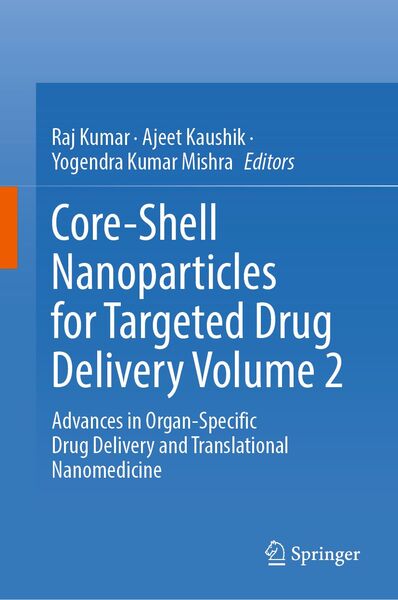
Core-Shell Nanoparticles for Targeted Drug Delivery Volume 2 Advances in Organ-Specific Drug Delivery and Translational Nanomedicine

213,99 €

inkl. gesetzl. MwSt., Versandkostenfrei


Beschreibung

This book provides a comprehensive overview of core-shell nanoparticles for stimuli-responsive, organ-specific drug delivery, combining fundamental principles with recent advances. It highlights how these nanostructures are engineered to transport therapeutic agents directly to targeted organs such as...

Beschreibung

This book provides a comprehensive overview of core-shell nanoparticles for stimuli-responsive, organ-specific drug delivery, combining fundamental principles with recent advances. It highlights how these nanostructures are engineered to transport therapeutic agents directly to targeted organs such as the brain, liver, lungs, kidney, breast, and pancreas through controlled architecture, functionalization, and responsiveness to local microenvironmental cues, underscoring their transformative role in precision medicine.

The background emphasizes the need for site-specific drug delivery systems that overcome limitations of conventional therapies, including poor bioavailability and systemic toxicity. Core-shell nanoparticles, with their layered design, improve drug encapsulation, stability, and biocompatibility while enabling controlled release. Their development reflects decades of progress in nanotechnology, pharmaceutics, and biomedical engineering, converging toward personalized and precision medicine.

Chapters span principles of targeted delivery, ligand-mediated strategies, and applications in personalized medicine, followed by organ-specific therapies for cancer, neurological disorders, and metabolic or endocrine diseases. Additional sections address preclinical models, clinical trials, nanotoxicology, regulatory perspectives, and commercialization challenges, enriched by contributions from international experts.

The audience includes researchers, pharmaceutical scientists, clinicians, and graduate students in nanomedicine, drug delivery, and biomaterials. Secondary readers such as healthcare professionals, industry innovators, and policymakers will also benefit. By combining foundational knowledge with translational case studies, this volume serves as both a scholarly reference and a practical guide for advancing smart therapeutics.

Portrait

Dr. Raj Kumar is Assistant Professor at the School of Health Sciences and Technology, UPES University, Dehradun, India. He earned his M.Sc. in Organic Chemistry from Osmania University and Ph.D. in Chemistry from IIT Mandi. With 14+ years of academic and research experience, he has advanced nanocarrier design for targeted drug delivery in gastric cancer, inflammatory bowel disease, contraception, and neural tissue engineering. His work has been funded by the UGC, SERB, Israel’s Planning and Budgeting Committee, and the NIH (USA). He has published 77 papers and chapters, with 3,300+ citations and an h-index of 34. He holds patents on solvent–antisolvent interaction methods and co-delivery systems using beta-glucan and mucoadhesive nanocarriers. Honors include the UGC Journal Research Fellowship, PBC Postdoctoral Fellowship (Israel), and DST National Postdoctoral Fellowship (India). He participated in the 71st Lindau Nobel Laureates Meeting (2021). His current focus is nano-biomaterials for drug delivery and tissue engineering.

Dr. Ajeet Kaushik is Assistant Professor of Chemistry in the Department of Environmental Engineering at Florida Polytechnic University, USA, where he leads the NanoBioTech Lab. His research spans green chemistry, electrochemical sensors, nanomedicine, and IoT-enabled diagnostics. He earned his Ph.D. in Chemistry through a joint program at the National Physical Laboratory and Jamia Millia Islamia, New Delhi, and pursued postdoctoral work in Ireland, South Korea, and the USA. He has authored 320+ peer-reviewed publications, edited 12 books, and holds three patents. Ranked among the top 2% of global scientists, his contributions include sensors, drug delivery, and biomedical nanotechnology. He mentors Ph.D. students internationally, collaborates across continents, and is a fellow/member of leading scientific societies. He serves on editorial boards and has received honors such as Fulbright Specialist recognition and the RSC Outstanding Reviewer Award.


Dr. Yogendra Kumar Mishra is Professor (WSR) at the Mads Clausen Institute, University of Southern Denmark, where he leads the Smart Materials Group within SDU NanoSYD. He earned his Ph.D. in Physics from Jawaharlal Nehru University/Inter-University Accelerator Centre, New Delhi (2008), and completed habilitation in Materials Science at Kiel University (2015). Previously, he led the 3D Nanomaterials Group at Kiel University as an Alexander von Humboldt Fellow. He is internationally recognized for pioneering flame-based synthesis of zinc oxide tetrapods and 3D hybrid networks. His research covers smart materials, hybrid composites, energy materials, sensors, biomaterials, catalysis, water purification, plasmonics, and photonics. He has authored 300+ publications with 18,000+ citations and an h-index of ~68. He serves on editorial boards, reviews for 200+ journals, evaluates grants, and contributes to international collaborations and scientific committees.


Produktdetails

Einband

Gebundene Ausgabe

Erscheinungsdatum

21.02.2027

Abbildungen

XII, 324 p. 50 illus., 49 illus. in color.

Herausgeber Raj Kumar + weitere

Produktdetails

Einband

Gebundene Ausgabe

Erscheinungsdatum

21.02.2027

Abbildungen

XII, 324 p. 50 illus., 49 illus. in color.

Herausgeber
Verlag Springer Singapore
Seitenzahl

324

Maße (B/H)

15,5/23,5 cm

Sprache

Englisch

ISBN

978-981-9248-90-2

Herstelleradresse

Springer Singapore
No. 12-2F 101 Business Park
47100 Puchong, Selangor D.E.
MY
Email: sdc-bookservice@springer.com
Telephone: +49 6221 3454301
Fax: +49 6221 3454229

Ein neues Kapitel für Ihre Bücher

Ein neues Kapitel für Ihre Bücher

Schenken Sie Ihren alten Schätzen ein zweites Leben und erhalten Sie dafür eine Thalia Geschenkkarte.

Jetzt verkaufen
Jetzt verkaufen

Noch keine Bewertungen vorhanden

Verfassen Sie die erste Bewertung zu diesem Artikel

Helfen Sie anderen Kundinnen und Kunden durch Ihre Meinung.

Kundinnen und Kunden meinen

Bewertungen (0)

  • Produktbild: Core-Shell Nanoparticles for Targeted Drug Delivery Volume 2
  • .- Chapter 1: Principles of Core-Shell Nanoparticles in Targeted Drug Delivery 

    .- Chapter 2: Ligand-Mediated Targeted Drug Delivery Strategies

    .- Chapter 3: Core-Shell Nanoparticles in Personalized and Precision Medicine

    .- Chapter 4: Core-Shell Nanoparticles for Targeted Drug Delivery to the Tumors

    .- Chapter 5: Core-Shell Nanoparticles for Targeted Drug Delivery to the Brain

    .- Chapter 6: Core-Shell Nanoparticles for Targeted Drug Delivery to the Liver 

    .- Chapter 7: Core-Shell Nanoparticles for Targeted Drug Delivery to the Lungs

    .- Chapter 8: Core–Shell Nanoparticles for Targeted Drug Delivery to the Breast Cancer

    .- Chapter 9: Core–Shell Nanoparticles for Targeted Drug Delivery to the Pancreas 

    .- Chapter 10: Core-Shell Nanoparticles for Targeted Drug Delivery to Metabolic Disorders

    .- Chapter 11: Core-Shell Nanoparticles in Preclinical Models and Animal Testing 

    .- Chapter 12: Core-Shell Nanoparticles for Targeted Drug Delivery in Clinical Trials.