















































KI-Beratung Beta

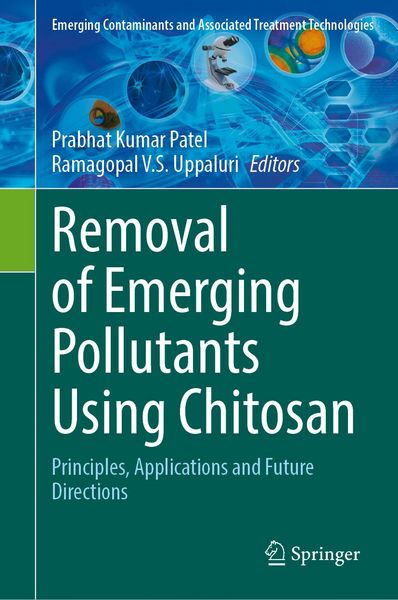
Produktbild: Removal of Emerging Pollutants Using Chitosan
Vorbesteller Neu

Removal of Emerging Pollutants Using Chitosan Principles, Applications and Future Directions

171,99 €

inkl. gesetzl. MwSt., Versandkostenfrei


Beschreibung

Produktdetails

Einband

Gebundene Ausgabe

Erscheinungsdatum

08.01.2027

Abbildungen

VI, 397 p. 44 illus., 36 illus. in color.

Herausgeber

Prabhat Kumar Patel + weitere

Verlag

Springer

Seitenzahl

397

Maße (B/H)

15,5/23,5 cm

Sprache

Englisch

ISBN

978-3-032-38163-7

Beschreibung

Portrait

Dr. Prabhat Kumar Patel earned his bachelor’s degree in Civil and Environmental Engineering in 2014 from Noida Institute of Engineering and Technology, Greater Noida, India and a master’s degree in Environmental Engineering in 2017 from Motilal Nehru National Institute of Technology, Allahabad (Prayagraj), India. Subsequently, he completed his Ph.D. in Environmental Engineering at the Indian Institute of Technology, Guwahati, India in 2023. Following that, he joined the Civil and Environmental Engineering Department at the Institute of Engineering and Technology, Lucknow, India as an Assistant Professor. He served there for 1 year and after that he joined the School of Science at Harbin Institute of Technology, Shenzhen, China. He served there for 1 year as a Postdoctoral researcher. After completing his 1st postdoctoral tenure, he secured C2F Postdoctoral Fellowship and he joined Chulalongkorn University, Bangkok as Postdoctoral Researcher. His research focuses on functional bio-composites, including chitosan-MOFs and chitosan-COFs, Biochar and their potential application in adsorptive removal of environmental pollutants such as PFAS, Microplastics, dyes and toxic metal ions. During his ongoing research journey, he has published 17 peer reviewed journal articles, 22 peer reviewed book chapters and 3 edited books on chitosan are under preparation.  


Prof. Ramagopal V. S. Uppaluri holds B.Tech. (Chemical Engineering) from Andhra University, Visakhapatnam; M.Tech. (Chemical Engineering) from IIT Kanpur and Ph.D. (Process Integration) from the University of Manchester, England. After a brief tenure of postdoctoral fellowship at Robert Gordon University, Scot-land, he joined IIT Guwahati and eventually became one of the youngest Professor and Professor (Higher Academic Grade) of IIT Guwahati. Till date, Prof. Uppaluri has guided 15 Ph.D. students at IIT Guwahati. Presently, he is supervising 20 Ph.D. students in diverse fields of rural food processing, polymer science and technology, solar energy applications, machine learning, bio-fertilizers, food product design and development, etc. He has published 116 international journal publications in diversi-fied areas of chemical engineering and science. He has been awarded/filed 6 Indian patents in the field of enhanced oil recovery, noble metal composite membrane fabri-cation and nano-clustered palladium catalyst fabrication. He also completed several funded projects from DBT, CSIR, DST, DRDL, OIL and IOCL. His extra-curricular interests are in the field of Vedanta & Science and Consciousness Studies.

Produktdetails

Einband

Gebundene Ausgabe

Erscheinungsdatum

08.01.2027

Abbildungen

VI, 397 p. 44 illus., 36 illus. in color.

Herausgeber

Verlag

Springer

Seitenzahl

397

Maße (B/H)

15,5/23,5 cm

Sprache

Englisch

ISBN

978-3-032-38163-7

Herstelleradresse

Springer Nature Customer Service Center GmbH
Europaplatz 3
69115 Heidelberg
DE
ProductSafety@springernature.com

Ein neues Kapitel für Ihre Bücher

Ein neues Kapitel für Ihre Bücher

Schenken Sie Ihren alten Schätzen ein zweites Leben und erhalten Sie dafür eine Thalia Geschenkkarte.

Jetzt verkaufen
Jetzt verkaufen

Noch keine Bewertungen vorhanden

Verfassen Sie die erste Bewertung zu diesem Artikel

Helfen Sie anderen Kundinnen und Kunden durch Ihre Meinung.

Kundinnen und Kunden meinen

Bewertungen (0)

  • Produktbild: Removal of Emerging Pollutants Using Chitosan
  • 1 Introduction to Emerging Contaminants.- 2 Chitosan: A Biopolymer for Emerging Pollutant Removal.- 3 Principles of Adsorption and Complexation in Chitosan-based Removal of Emerging Pollutants.- 4 Modifications in the Chitosan Framework.- 5 Nutrient Recovery Utilizing Chitosan-based Adsorbents.- 6 Future Prospects of Nutrient Recovery and Regeneration of Chitosan-based Adsorbents.- 7 Chitosan-based Adsorbents for Emerging Pollutant Removal.- 8 Emerging Pollutant Removal Mechanisms Using Chitosan.- 9 Chitosan-Based Membranes for Emerging Pollutant Removal.- 10 Emerging Pollutant Removal Using Chitosan-Based Hydrogels, Beads, Microcapsules, Aerogels.- 11 Chitosan-Based Nanocomposites for Emerging Pollutant Removal.- 12 Chitosan-Based Fibers and Foams for Emerging Pollutant Removal.- 13 Chitosan-Assisted Biochar for Emerging Pollutant Removal.- 14 Chitosan-Based Nanofibers for Emerging Pollutant Removal.- 15 Chitosan-Based MOFs and COFs for Emerging Pollutant Removal.- 16 Cost-Effectiveness of Chitosan-Based Composites.