















































KI-Beratung Beta

Gutscheinbedingungen

Gültig bis 11.11.2026 | Gültig für Spielzeug, Filme, Musik, Software, Games, Geschenke & Trends, Schreibwaren, Hörbücher und Hörbuch-Downloads (außer Abo & Shelfies), gebrauchte Bücher, nicht preisgebundene Bücher und Kalender | Einlösbar unter thalia.de und in der Thalia App | Click & Collect nur mit Online-Zahlung (Paypal/Kreditkarte) vorab | Einzelne Artikel können ausgeschlossen sein | Nicht kombinierbar mit anderen Gutscheinen oder Preisaktionen | Nur einmal pro Einkauf einlösbar | Gutschein wird auf max. 500€ Bestellwert angerechnet | Keine Barauszahlung | Digitale Hörbücher nur für Android  | Nicht gültig für preisgebundene Artikel (aufgrund der Buchpreisbindung sind Gutscheine nicht auf Bücher, eBooks, Presse einlösbar), tolino eReader & Zubehör, Abonnements & Flatrates, Geschenkkarten, Versandkosten und Services

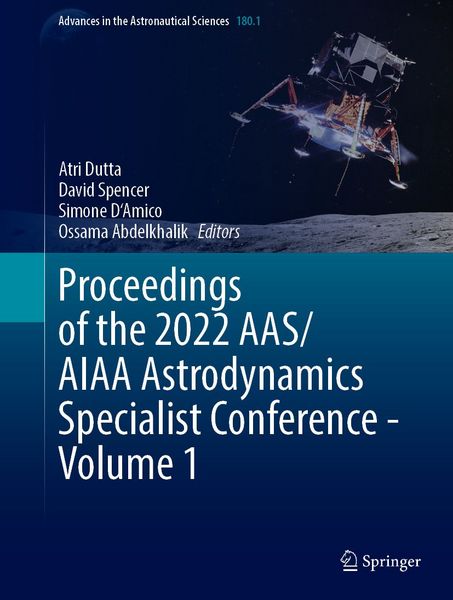
Produktbild: Proceedings of the 2022 AAS/AIAA Astrodynamics Specialist Conference - Volume 1
Band 180 Vorbesteller

Proceedings of the 2022 AAS/AIAA Astrodynamics Specialist Conference - Volume 1

319,99 €

inkl. gesetzl. MwSt., Versandkostenfrei


Beschreibung

Produktdetails

Einband

Gebundene Ausgabe

Erscheinungsdatum

24.02.2027

Abbildungen

XXVII, 419 p.

Herausgeber

Atri Dutta + weitere

Verlag

Springer

Seitenzahl

419

Maße (B/H)

21/27,9 cm

Sprache

Englisch

ISBN

978-3-032-38431-7

Beschreibung

Portrait

Atri Dutta is a Professor in the Department of Aerospace Engineering, Wichita State University (WSU), with expertise in the areas of astrodynamics, control systems, mission design and optimization. His research focuses on low-thrust trajectory optimization, mission design for in-space neutrino detection experiments, CubeSat constellation design, and on-orbit servicing. At WSU, he directed the Disaster Resilience and Analytics Center from 2021-25. He is an Associate Fellow of American Institute of Aeronautics and Astronautics (AIAA). He is a member of American Astronautical Society (AAS) and Institute of Electrical and Electronic Engineers (IEEE). He serves on the Astrodynamics Technical Committee of AIAA. All his degrees are in Aerospace Engineering, with Bachelors (2002) from Indian Institute of Technology, Kharagpur, and M.S. (2005) & Ph.D. (2009) degrees from Georgia Tech.

David B. Spencer is the Vice President for Publications for The American Astronautical Society. In this role, he oversees the publications portfolio for the society. He is Professor Emeritus of Aerospace Engineering at Penn State University. He is also a Senior Project Leader at The Aerospace Corporation in Chantilly, Virginia.

Simone D’Amico is Associate Professor of Aeronautics and Astronautics and Geophysics (by Courtesy), Science Fellow at the Hoover Institution, Co-Founder and Chief Science Officer at EraDrive Inc. He is the Founding Director of the Stanford Space Rendezvous Laboratory, Founding Co-Director of the Center for AEroSpace Autonomy Research (CAESAR), and Director of the Undergraduate Program in Aerospace Engineering at Stanford. He has 20+ years of experience in research and development of autonomous spacecraft and distributed space systems. He developed and deployed the distributed Guidance, Navigation, and Control (GNC) system of several formation-flying, swarming, rendezvous and proximity operations missions (e.g. PRISMA, TanDEM-X, and STARLING). Dr. D’Amico is Fellow of AIAA and AAS. He is on the Advisory Board of four space start-ups focusing on distributed space systems. He was the recipient of several Best Paper Awards at AMOS (2025), IAF (2022), IEEE (2021), AIAA (2021), AAS (2019) conferences, and the M. Barry Carlton Award by IEEE (2020). He received the B.S. and M.S. degrees from Politecnico di Milano (2003) and the Ph.D. degree from Delft University of Technology (2010).

Ossama Abdelkhalik is a professor, and the Vance D. Coffman faculty chair, in the Department of Aerospace Engineering at Iowa State University, in Ames, Iowa. Dr. Abdelkhalik received his Ph.D. in aerospace engineering from Texas A&M University, College Station, TX, as well as a B.S. and M.S. degrees in aerospace engineering from Cairo University, Egypt. His research interests are in the areas of orbital mechanics, spacecraft dynamics, optimal control, and space trajectory optimization. He authored and co-authored more than 150 journal and conference articles, a book, and 7 patents. Dr. Abdelkhalik is Associate Fellow of AIAA, a senior member of the American Astronautical Society (AAS), IEEE, and a member of the AIAA Technical Committee on Astrodynamics. Dr. Abdelkhalik is the AIAA General Chair of the 2014 AAS/AIAA Space Flight Mechanics Meeting, and the 2022 AAS/AIAA Astrodynamics Specialist Conference.

Produktdetails

Einband

Gebundene Ausgabe

Erscheinungsdatum

24.02.2027

Abbildungen

XXVII, 419 p.

Herausgeber

Verlag

Springer

Seitenzahl

419

Maße (B/H)

21/27,9 cm

Sprache

Englisch

ISBN

978-3-032-38431-7

Herstelleradresse

Springer Nature Customer Service Center GmbH
Europaplatz 3
69115 Heidelberg
DE
ProductSafety@springernature.com

Ein neues Kapitel für Ihre Bücher

Ein neues Kapitel für Ihre Bücher

Schenken Sie Ihren alten Schätzen ein zweites Leben und erhalten Sie dafür eine Thalia Geschenkkarte.

Jetzt verkaufen
Jetzt verkaufen

Noch keine Bewertungen vorhanden

Verfassen Sie die erste Bewertung zu diesem Artikel

Helfen Sie anderen Kundinnen und Kunden durch Ihre Meinung.

Kundinnen und Kunden meinen

Bewertungen (0)

  • Produktbild: Proceedings of the 2022 AAS/AIAA Astrodynamics Specialist Conference - Volume 1
  • Part 1: Asteroid, Earth, and Planetary Missions.- Chapter 1: Use of powered Earth fly-bys to enhance mass retrieval for a two-spacecraft asteroid capture strategy.- Part 2: Dynamical Systems Theory & Trajectory Design.- Chapter 2: Implementation of the Solar Exclusion Zone Burn Through Maneuvers for DSCOVR to Preserve Fuel for the Gyro-less Spacecraft in a Sun-Earth L1 Lissajous Orbit.- Part 3: Guidance and Control of Launch and Atmospheric Entry Vehicles.- Chapter 3: Convex Approach to Stochastic Control for Autonomous Rocket Pinpoint Landing.- Chapter 4: Estimation of aerodynamic angles and wind components for a launch vehicle.- Part 4: Machine Learning and Autonomy in Astrodynamics.- Chapter 5: Optimizing a Long Short-Term Memory Neural Network to Forecast Solar Radio Flux.- Chapter 6: Performance Enhancements for Autonomous Flight Control Using Hierarchical Ensembles of Autonomous Decision Systems.- Chapter 7: Small Body Reconnaissance By Multiple Spacecraft Via Deep Reinforcement Learning.- Chapter 8: Autonomous Rendezvous And Docking Of Spacecraft Using Hierarchical Model Based Reinforcement Learning.- Part 5: Orbital Debris and Space Environment.- Chapter 9: Accuracy of Density and Accommodation Coefficient Estimates as a Function of Drag Force and Torque Errors for a Paddlewheel CubeSat.- Part 6: Relative Motion and Formation Flying.- Chapter 10: Spacecraft Formation Flying Control Switching Surface Based on Relative Orbital Elements.- Chapter 11: Modeling and Analysis of Spacecraft Formation Flying Under the Effects of J2, Drag and Lift Perturbation Forces.- Chapter 12: HelioSwarm: Swarm Design Methods in Eccentric P/2 Lunar Resonant Orbit.- Chapter 13: Multibody Dynamics on SE(3)n with Applications to Optical System Formation.- Chapter 14: Covariance-Based Observability Analysis Method For Angles-Only Rendezvous Navigation.- Chapter 15: Simulating a Dynamics-Informed Cislunar RPO Mission Incorporating Orbit Determination.- Chapter 16: Nonlinear Dynamics and Control of J2 and Drag Perturbed Spacecraft Formation Flying via SDRE Technique.- Chapter 17: LISA Point-Ahead Angle Control for Optimal Tilt-to-Length Noise Estimation.- Chapter 18: Maximizing Observation Throughput via Multi-Stage Satellite Constellation Reconfiguration.- Chapter 19: Design Considerations for Attitude Consensus Control of Two Flexible Spacecraft.- Chapter 20: Calibrated Kalman Filtering in Relative Orbit Estimation.- Part 7: Space Domain Awareness.- Chapter 21: Resident Space Objects Detection and Tracking Based On Artificial Intelligence.- Chapter 22: Dynamics-Based Uncertainty Propagation with Low-Thrust.- Chapter 23: Parallelization Techniques for Quantifying Uncertainty Using Embedded Hardware.