















































KI-Beratung Beta

Gutscheinbedingungen

Gültig bis 11.11.2026 | Gültig für Spielzeug, Filme, Musik, Software, Games, Geschenke & Trends, Schreibwaren, Hörbücher und Hörbuch-Downloads (außer Abo & Shelfies), gebrauchte Bücher, nicht preisgebundene Bücher und Kalender | Einlösbar unter thalia.de und in der Thalia App | Click & Collect nur mit Online-Zahlung (Paypal/Kreditkarte) vorab | Einzelne Artikel können ausgeschlossen sein | Nicht kombinierbar mit anderen Gutscheinen oder Preisaktionen | Nur einmal pro Einkauf einlösbar | Gutschein wird auf max. 500€ Bestellwert angerechnet | Keine Barauszahlung | Digitale Hörbücher nur für Android  | Nicht gültig für preisgebundene Artikel (aufgrund der Buchpreisbindung sind Gutscheine nicht auf Bücher, eBooks, Presse einlösbar), tolino eReader & Zubehör, Abonnements & Flatrates, Geschenkkarten, Versandkosten und Services

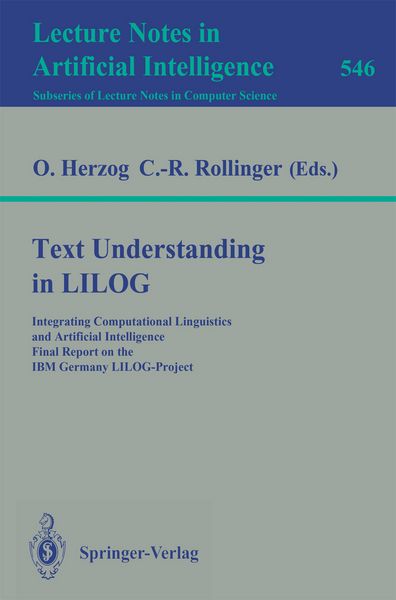
  • Produktbild: Text Understanding in LILOG
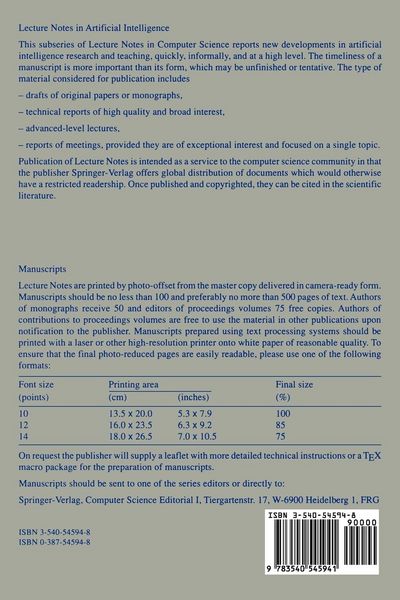
  • Produktbild: Text Understanding in LILOG
Gebraucht - 60%

Text Understanding in LILOG Integrating Computational Linguistics and Artificial Intelligence. Final Report on the IBM Germany LILOG-Project

60% sparen

21,19 € 53,49 € *

inkl. gesetzl. MwSt., Versandkostenfrei

*ggü. gebundenem Ladenpreis bzw. UVP für Neuware.

Lieferung nach Hause

Beschreibung

The IBM project LILOG presented in this volume represents a fundamental stepbeyond computer science as hitherto understood. It was a successful project in every respect and has shed light on conjectured basic interrelations between knowledge processing and language definition. Knowledge processing is strongly...

Beschreibung

The IBM project LILOG presented in this volume represents a
fundamental stepbeyond computer science as hitherto
understood. It was a successful project in every respect and
has shed light on conjectured basic interrelations between
knowledge processing and language definition. Knowledge
processing is strongly coupled to the natural language used,
and for applied knowledge processing an information base is
neededwhich defines the semantic contents and
interrelations of the language.
The LILOG project was an implementation of an information
basein the German language. A set of tools was also
developed to work with the system, including structured
man-machine interfaces using natural language, inference
algorithms, and a complete subsystem to acquire and store
the required knowledge.
The LILOG project started in 1985 and a functional system
was demonstrated in 1991. The project involved approximately
200 of the scientists working in Germany in the fields of
computational linguistics, natural language understanding
systems, and artificial intelligence. The project proves
that a cooperative project between universities and industry
can produce useful results both in pure research and in
implemented methods and tools.

Produktdetails

Zustand

Akzeptabel

Einband

Taschenbuch

Erscheinungsdatum

25.09.1991

Herausgeber Otthein Herzog + weitere

Produktdetails

Zustand

Akzeptabel

Einband

Taschenbuch

Erscheinungsdatum

25.09.1991

Herausgeber
Verlag Springer Berlin
Seitenzahl

744

Maße (L/B/H)

23,5/15,5/4,1 cm

Gewicht

1124 g

Auflage

1991

Sprache

Englisch

EAN

2710005886988

Herstelleradresse

Springer-Verlag KG
Sachsenplatz 4-6
1201 Wien
AT

Email: ProductSafety@springernature.com

Ein neues Kapitel für Ihre Bücher

Ein neues Kapitel für Ihre Bücher

Schenken Sie Ihren alten Schätzen ein zweites Leben und erhalten Sie dafür eine Thalia Geschenkkarte.

Jetzt verkaufen
Jetzt verkaufen

Noch keine Bewertungen vorhanden

Verfassen Sie die erste Bewertung zu diesem Artikel

Helfen Sie anderen Kundinnen und Kunden durch Ihre Meinung.

Kundinnen und Kunden meinen

Bewertungen (0)

  • Produktbild: Text Understanding in LILOG
  • Produktbild: Text Understanding in LILOG
  • Introducing LILOG.- Text understanding — The challenges to come.- A formalism for natural language — STUF.- The language of STUF.- Chart-parsing of STUF grammars.- The STUF workbench.- Unification-ID/LP grammars: Formalization and parsing.- A flexible parser for a Linguistic Development Environment.- Gap-Handling mechanisms in categorial grammars.- Outlines of the LEU/2 lexicology.- Morphological processing in the two-level paradigm.- Representing word meanings.- Sortal information in lexical concepts.- Incremental vocabulary extensions in text understanding systems.- Managing lexical knowledge in LEU/2.- The grammars of LILOG.- An alternative phrase structure account of symmetric coordination.- Verb order and head movement.- The Bermuda Triangle: Natural language semantics between linguistics, knowledge representation, and knowledge processing.- Presupposition, anaphora, and lexical content.- Anaphora and domain restriction.- On representing the temporal structure of texts.- The treatment of plurality in L LILOG.- The knowledge representation language LLILOG.- Knowledge packets and knowledge packet structures.- Deductive aspects of three-valued logic.- The LILOG inference engine.- Knowledge based control of the LILOG inference engine: Kinds of metaknowledge.- Attributive description formalisms ... and the rest of the world.- The background knowledge of the LILOG system.- The LILOG ontology from a linguistic point of view.- A knowledge engineering environment for LILOG.- Knowledge engineering in the context of related fields of research.- LILOG-DB: Database support for knowledge based systems.- Processing of spatial expressions in LILOG.- Phenomena of localization.- Verbs of motion and position: On the optionality of the local argument.- Why a hill can't be a valley: Representing gestalt and position properties of objects with object schemata.- Object-oriented representation of depictions on the basis of cell matrices.- Integrating a generation component into a natural language understanding system.- From knowledge structures to text structures.- The formulator.- Constructing a context for LEU/2.- The text understanding system LEU/2.- The trace of building a large AI system.