















































KI-Beratung Beta

Gutscheinbedingungen

Gültig bis 30.11.2026 | Gültig für nicht preisgebundene fremdsprachige Bücher | Einzelne Artikel können ausgeschlossen sein | Online auf thalia.de und in der Thalia App einlösbar | Click & Collect nur mit Online-Zahlung (Paypal/Kreditkarte) vorab | Nicht kombinierbar mit anderen Gutscheinen oder Preisaktionen | Nur einmal pro Einkauf einlösbar | Gutschein wird auf max. 500€ Bestellwert angerechnet | Keine Barauszahlung | Nicht gültig für Versandkosten und Services

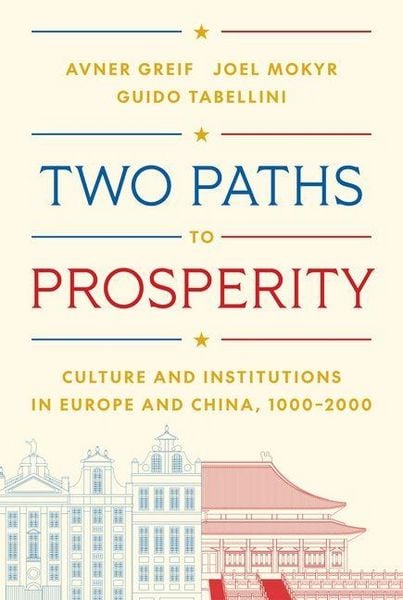
Produktbild: Two Paths to Prosperity
Vorbesteller Neu

Two Paths to Prosperity Culture and Institutions in Europe and China, 1000-2000

28,99 €

inkl. gesetzl. MwSt., Versandkostenfrei


Beschreibung

How the social organization of Europe and China shaped their divergent economic and political trajectories over the past millennium

In the eleventh century, when Europe was still backward and poor, China was a rich and sophisticated civilization. Yet Europe became the birthplace of democracy and the...

Beschreibung

How the social organization of Europe and China shaped their divergent economic and political trajectories over the past millennium

In the eleventh century, when Europe was still backward and poor, China was a rich and sophisticated civilization. Yet Europe became the birthplace of democracy and the Industrial Revolution, driving the Great Enrichment, while China stagnated until the end of the twentieth century and was always ruled by autocracies. Two Paths to Prosperity traces the emergence of two very different social organizations in premodern China and Europe--the clan and the corporation--showing how they were key factors in the economic and political divergence of these two great civilizations.

In this landmark book, three leading economists offer a bold new account of why Europe and China evolved along such different trajectories. In the early Middle Ages, public goods like risk sharing, religious worship, education, and conflict resolution were provided by nonstate organizations in both societies. China increasingly relied on kin-based cooperation within clans, while weaker kinship ties in Europe gave rise to corporations such as guilds, universities, and self-governing towns. Despite performing similar functions, clans and corporations were built on very different principles--with lasting consequences until today.

Providing a novel answer to a fundamental question in economic and political history, Two Paths to Prosperity shows how extended kinship in Chinese society facilitated the consolidation of autocracy and hindered innovation and economic development, and how corporations in Europe influenced emerging state institutions and set the stage for the Industrial Revolution.

Produktdetails

Einband

Taschenbuch

Erscheinungsdatum

01.06.2027

Abbildungen

16 b/w illus. 11 tables. 1 map.

Verlag University Presses

Produktdetails

Einband

Taschenbuch

Erscheinungsdatum

01.06.2027

Abbildungen

16 b/w illus. 11 tables. 1 map.

Verlag University Presses
Seitenzahl

544

Maße (L/B)

21,6/14 cm

Sprache

Englisch

ISBN

978-0-691-26772-2

Herstelleradresse

Libri GmbH
Europaallee 1
36244 Bad Hersfeld
DE

Email: gpsr@libri.de

Ein neues Kapitel für Ihre Bücher

Ein neues Kapitel für Ihre Bücher

Schenken Sie Ihren alten Schätzen ein zweites Leben und erhalten Sie dafür eine Thalia Geschenkkarte.

Jetzt verkaufen
Jetzt verkaufen

Noch keine Bewertungen vorhanden

Verfassen Sie die erste Bewertung zu diesem Artikel

Helfen Sie anderen Kundinnen und Kunden durch Ihre Meinung.

Kundinnen und Kunden meinen

Bewertungen (0)

Die Leseprobe wird geladen.
  • Produktbild: Two Paths to Prosperity