















































KI-Beratung Beta

  • Produktbild: Quantum Mechanics
  • Produktbild: Quantum Mechanics
- 10%

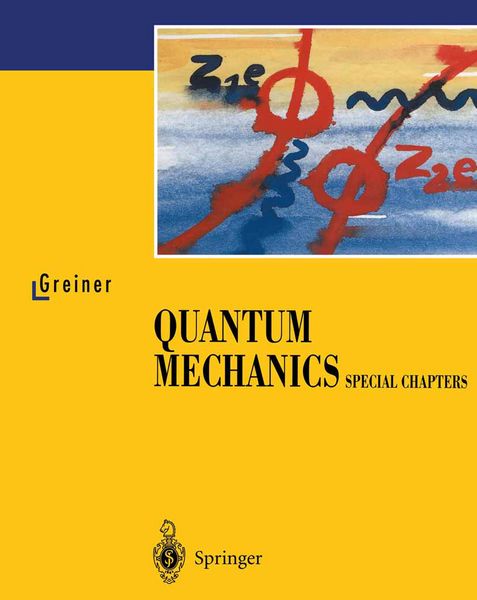
Quantum Mechanics Special Chapters

10% sparen

95,99 € UVP 106,99 €

inkl. gesetzl. MwSt., Versandkostenfrei


Beschreibung

Produktdetails

Einband

Taschenbuch

Erscheinungsdatum

11.12.1997

Abbildungen

XVIII, 378 p.

Verlag

Springer Berlin

Seitenzahl

378

Maße (L/B/H)

24,2/19,3/2,2 cm

Gewicht

774 g

Auflage

1998

Sprache

Englisch

ISBN

978-3-540-60073-2

Beschreibung

Produktdetails

Einband

Taschenbuch

Erscheinungsdatum

11.12.1997

Abbildungen

XVIII, 378 p.

Verlag

Springer Berlin

Seitenzahl

378

Maße (L/B/H)

24,2/19,3/2,2 cm

Gewicht

774 g

Auflage

1998

Sprache

Englisch

ISBN

978-3-540-60073-2

Herstelleradresse

Springer-Verlag KG
Sachsenplatz 4-6
1201 Wien
AT

Email: ProductSafety@springernature.com

Ein neues Kapitel für Ihre Bücher

Ein neues Kapitel für Ihre Bücher

Schenken Sie Ihren alten Schätzen ein zweites Leben und erhalten Sie dafür eine Thalia Geschenkkarte.

Jetzt verkaufen
Jetzt verkaufen

Noch keine Bewertungen vorhanden

Verfassen Sie die erste Bewertung zu diesem Artikel

Helfen Sie anderen Kundinnen und Kunden durch Ihre Meinung.

Kundinnen und Kunden meinen

Bewertungen (0)

  • Produktbild: Quantum Mechanics
  • Produktbild: Quantum Mechanics
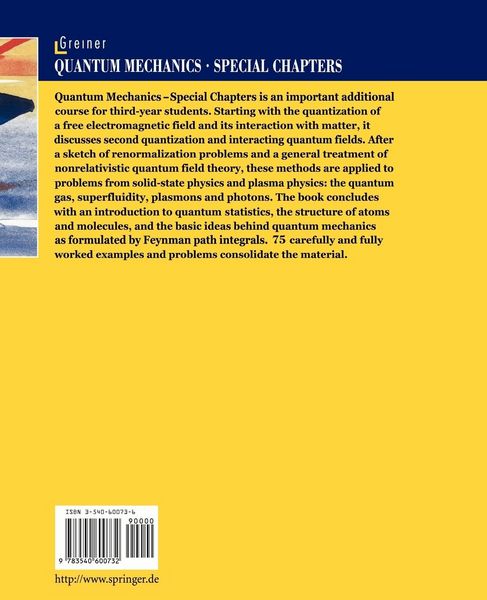
  • 1. Quantum Theory of Free Electromagnetic Fields.- 1.1 Maxwell’s Equations.- 1.2 Electromagnetic Plane Waves.- 1.3 Quantization of Free Electromagnetic Fields.- 1.4 Eigenstates of Electromagnetic Fields.- 1.5 Coherent States (Glauber States) of Electromagnetic Fields.- 1.6 Biographical Notes.- 2. Interaction of Electromagnetic Fields with Matter.- 2.1 Emission of Radiation from an Excited Atom.- 2.2 Lifetime of an Excited State.- 2.3 Absorption of Photons.- 2.4 Photon Scattering from Free Electrons.- 2.5 Calculation of the Total Photon Scattering Cross Section.- 2.6 Cherenkov Radiation of a Schrödinger Electron.- 2.7 Natural Linewidth and Self-energy.- 3. Noninteracting Fields.- 3.1 Spin-Statistics Theorem.- 3.2 Relationship Between Second Quantization and Elementary Quantum Mechanics.- 4. Quantum Fields with Interaction.- 5. Infinities in Quantum Electrodynamics: Renormalization Problems.- 5.1 Attraction of Parallel, Conducting Plates Due to Field Quantum Fluctuations (Casimir Effect).- 5.2 Renormalization of the Electron Mass.- 5.3 The Splitting of the Hydrogen States 2s1/2?2p3/2: The Lamb Shift.- 5.4 Is There an Inconsistency in Bethe’s Approach?.- 6. Nonrelativistic Quantum Field Theory of Interacting Particles and Its Applications.- 6.1 Quantum Gases.- 6.2 Nearly Ideal, Degenerate Bose—Einstein Gases.- 7. Superfluidity.- 7.1 Basics of a Microscopic Theory of Superfluidity.- 7.2 Landau’s Theory of Superfluidity.- 8. Pair Correlations Among Fermions and Bosons.- 8.1 Pair-Correlation Function for Fermions.- 8.2 Pair-Correlation Function for Bosons.- 8.3 The Hanbury-Brown and Twiss Effect.- 8.4 Cooper Pairs.- 9. Quasiparticles in Plasmas and Metals: Selected Topics.- 9.1 Plasmons and Phonons.- 10. Basics of Quantum Statistics.- 10.1 Concept of Quantum Statistics and the Notion of Entropy.- 10.2 Density Operator of a Many-Particle State.- 10.3 Dynamics of a Quantum-Statistical Ensemble.- 10.4 Ordered and Disordered Systems: The Density Operator and Entropy.- 10.5 Stationary Ensembles.- 11. Structure of Atoms.- 11.1 Atoms with Two Electrons.- 11.2 The Hartree Method.- 11.3 Thomas—Fermi Method.- 11.4 The Hartree—Fock Method.- 11.5 On the Periodic System of the Elements.- 11.6 Splitting of Orbital Multiplets.- 11.7 Spin—Orbit Interaction.- 11.8 Treatment of the Spin-Orbit Splitting in the Hartree—Fock Approach.- 11.9 The Zeeman Effect.- 11.10 Biographical Notes.- 12. Elementary Structure of Molecules.- 12.1 Born—Oppenheimer Approximation.- 12.2 The H+2 Ion as an Example.- 12.3 The Hydrogen Molecule.- 12.4 Electron Pairing.- 12.5 Spatially Oriented Orbits.- 12.6 Hybridization.- 12.7 Hydrocarbons.- 12.8 Biographical Notes.- 13. Feynman’s Path Integral Formulation of Schrödinger’s Wave Mechanics.- 13.1 Action Functional in Classical Mechanics and Schrödinger’s Wave Mechanics.- 13.2 Transition Amplitude as a Path Integral.- 13.3 Path Integral Representation of the Schrödinger Propagator.- 13.4 Alternative Derivation of the Schrödinger Equation.- 13.5 Biographical Notes.