















































KI-Beratung Beta

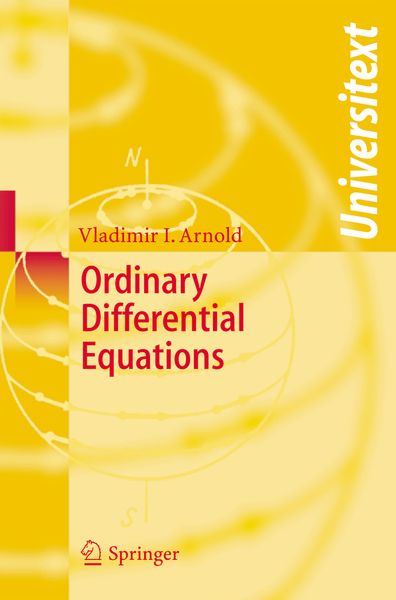
  • Produktbild: Ordinary Differential Equations
  • Produktbild: Ordinary Differential Equations

Ordinary Differential Equations

Aus der Reihe Universitext

71,99 €

inkl. gesetzl. MwSt., Versandkostenfrei


Beschreibung

The first two chapters of this book have been thoroughly revised and sig nificantly expanded. Sections have been added on elementary methods of in tegration (on homogeneous and inhomogeneous first-order linear equations and on homogeneous and quasi-homogeneous equations), on first-order linear and quasi-linear...

Beschreibung

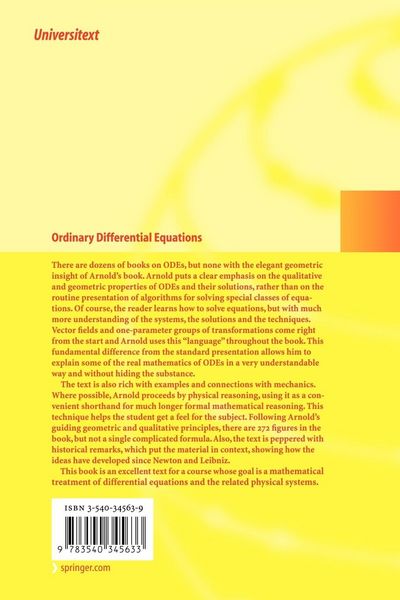
The first two chapters of this book have been thoroughly revised and sig nificantly expanded. Sections have been added on elementary methods of in tegration (on homogeneous and inhomogeneous first-order linear equations and on homogeneous and quasi-homogeneous equations), on first-order linear and quasi-linear partial differential equations, on equations not solved for the derivative, and on Sturm's theorems on the zeros of second-order linear equa tions. Thus the new edition contains all the questions of the current syllabus in the theory of ordinary differential equations. In discussing special devices for integration the author has tried through out to lay bare the geometric essence of the methods being studied and to show how these methods work in applications, especially in mechanics. Thus to solve an inhomogeneous linear equation we introduce the delta-function and calculate the retarded Green's function; quasi-homogeneous equations lead to the theory of similarity and the law of universal gravitation, while the theorem on differentiability of the solution with respect to the initial conditions leads to the study of the relative motion of celestial bodies in neighboring orbits. The author has permitted himself to include some historical digressions in this preface. Differential equations were invented by Newton (1642-1727).

Rezension

"Professor Arnold has expanded his classic book to include new material on exponential growth, predator-prey, the pendulum, impulse response, symmetry groups and group actions, perturbation and bifurcation … . The new edition is highly recommended as a general reference for the essential theory of ordinary differential equations and as a textbook for an introductory course for serious undergraduate or graduate students. … In the US system, it is an excellent text for an introductory graduate course." (Carmen Chicone, SIAM Review, Vol. 49 (2), 2007)


"Vladimir Arnold’s is a master, not just of the technical realm of differential equations but of pedagogy and exposition as well. … The writing throughout is crisp and clear. … Arnold’s says that the book is based on a year-long sequence of lectures for second-year mathematics majors in Moscow. In the U.S., this material is probably most appropriate for advanced undergraduates or first-year graduate students." (William J. Satzer, MathDL, August, 2007)

Produktdetails

Einband

Taschenbuch

Erscheinungsdatum

19.06.2006

Abbildungen

IV, 338 p. 272 illus.

Verlag Springer Berlin

Produktdetails

Einband

Taschenbuch

Erscheinungsdatum

19.06.2006

Abbildungen

IV, 338 p. 272 illus.

Verlag Springer Berlin
Seitenzahl

338

Maße (L/B/H)

23,5/15,5/1,9 cm

Gewicht

522 g

Auflage

1st ed 1992. 2nd printing 2006

Übersetzt von

R. Cooke

Sprache

Englisch

ISBN

978-3-540-34563-3

Herstelleradresse

Springer-Verlag GmbH
Europaplatz 3
69115 Heidelberg
DE

Email: ProductSafety@springernature.com

Ein neues Kapitel für Ihre Bücher

Ein neues Kapitel für Ihre Bücher

Schenken Sie Ihren alten Schätzen ein zweites Leben und erhalten Sie dafür eine Thalia Geschenkkarte.

Jetzt verkaufen
Jetzt verkaufen

Noch keine Bewertungen vorhanden

Verfassen Sie die erste Bewertung zu diesem Artikel

Helfen Sie anderen Kundinnen und Kunden durch Ihre Meinung.

Kundinnen und Kunden meinen

Bewertungen (0)

  • Produktbild: Ordinary Differential Equations
  • Produktbild: Ordinary Differential Equations
  • Basic Concepts.- Basic Theorems.- Linear Systems.- Proofs of the Main Theorems.- Differential Equations on Manifolds.