















































KI-Beratung Beta

Gutscheinbedingungen

Gültig bis 30.11.2026 | Gültig für nicht preisgebundene fremdsprachige Bücher | Einzelne Artikel können ausgeschlossen sein | Online auf thalia.de und in der Thalia App einlösbar | Click & Collect nur mit Online-Zahlung (Paypal/Kreditkarte) vorab | Nicht kombinierbar mit anderen Gutscheinen oder Preisaktionen | Nur einmal pro Einkauf einlösbar | Gutschein wird auf max. 500€ Bestellwert angerechnet | Keine Barauszahlung | Nicht gültig für Versandkosten und Services

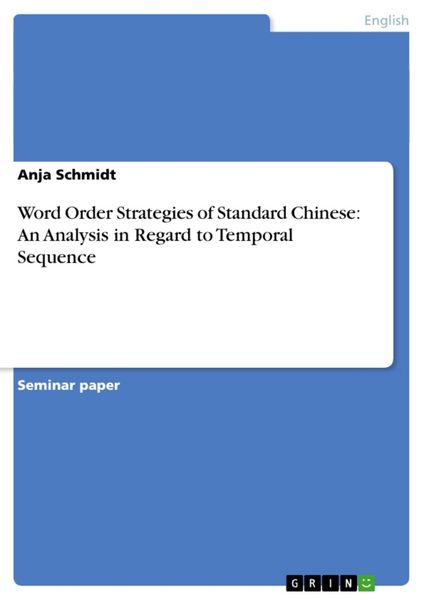
Produktbild: Word Order Strategies of Standard Chinese: An Analysis in Regard to Temporal Sequence

Word Order Strategies of Standard Chinese: An Analysis in Regard to Temporal Sequence

17,95 €

inkl. gesetzl. MwSt., Versandkostenfrei


Beschreibung

Seminar paper from the year 2004 in the subject American Studies - Linguistics, grade: 1+ (A+), University of Hamburg, course: Motivation in Language, language: English, abstract: Linguists studying the syntactic relations of Chinese have often argued that Chinese, being a non-inflectional language,...

Beschreibung

Seminar paper from the year 2004 in the subject American Studies - Linguistics, grade: 1+ (A+), University of Hamburg, course: Motivation in Language, language: English, abstract: Linguists studying the syntactic relations of Chinese have often argued that Chinese, being a non-inflectional language, was more reliant on iconic principles than most Western languages. Since Chinese is largely dependent on the use of grammatical particles and word order, it was sought to represent conceptual mappings more directly than other languages, i.e. denoting states and events as direct reflections of human perceptions. But how iconic is Chinese really? And what are the main determinants of Chinese word order? The aim of this paper is to investigate the influence of temporal sequence on Chinese word order. I will in particular examine the pre- and post-verbal placement of adverbials and try to display the limitations of this theory. I will furthermore demonstrate how other factors can account for word order questions not sufficiently resolved by the "Principle of Temporal Sequence". Accordingly, I will try to show that not just one major parameter is involved in Chinese word order, but several - interacting to various degrees in different contexts. For this purpose, I have examined Chinese sample sentences taken from dictionaries, as well as Chinese language learning material and grammar books. My analysis was moreover verified by the intuitions of native speakers of Chinese and is only concerned with "Standard Chinese", or Putonghua (PTH) - the standardized variant of Chinese as it is used on mainland China since the 1950s. Hence, I will start this analysis with a discussion of the "Principle of Temporal Sequence", its possible means for Chinese word order and its limitations. I will then consider other influences, e.g. topicality and definiteness by examining problematic cases of word order which can otherwise not be explained thoroughly by the temporal sequence hypothesis. A brief summary will conclude this investigation, pointing to further possible determiners of Chinese word order.

Produktdetails

Einband

Taschenbuch

Erscheinungsdatum

27.09.2007

Verlag GRIN
Seitenzahl

32

Produktdetails

Einband

Taschenbuch

Erscheinungsdatum

27.09.2007

Verlag GRIN
Seitenzahl

32

Maße (L/B/H)

21/14,8/0,3 cm

Gewicht

62 g

Auflage

2. Auflage

Sprache

Englisch

ISBN

978-3-638-76088-1

Herstelleradresse


Email: info@bod.de

Ein neues Kapitel für Ihre Bücher

Ein neues Kapitel für Ihre Bücher

Schenken Sie Ihren alten Schätzen ein zweites Leben und erhalten Sie dafür eine Thalia Geschenkkarte.

Jetzt verkaufen
Jetzt verkaufen

Noch keine Bewertungen vorhanden

Verfassen Sie die erste Bewertung zu diesem Artikel

Helfen Sie anderen Kundinnen und Kunden durch Ihre Meinung.

Kundinnen und Kunden meinen

Bewertungen (0)

Die Leseprobe wird geladen.
  • Produktbild: Word Order Strategies of Standard Chinese: An Analysis in Regard to Temporal Sequence