















































KI-Beratung Beta

Gutscheinbedingungen

Gültig bis 30.11.2026 | Gültig für nicht preisgebundene fremdsprachige Bücher | Einzelne Artikel können ausgeschlossen sein | Online auf thalia.de und in der Thalia App einlösbar | Click & Collect nur mit Online-Zahlung (Paypal/Kreditkarte) vorab | Nicht kombinierbar mit anderen Gutscheinen oder Preisaktionen | Nur einmal pro Einkauf einlösbar | Gutschein wird auf max. 500€ Bestellwert angerechnet | Keine Barauszahlung | Nicht gültig für Versandkosten und Services

  • Produktbild: Nutrigenomics
  • Produktbild: Nutrigenomics
- 10%

Nutrigenomics

10% sparen

124,99 € UVP 139,09 €

inkl. gesetzl. MwSt., Versandkostenfrei


Beschreibung

The fascinating area of Nutrigenomics describes this daily communication between diet, food and nutrients, their metabolites and our genome. This book describes how nutrition shapes human evolution and demonstrates its consequences for our susceptibility to diseases, such as diabetes and atherosclerosis....

Beschreibung

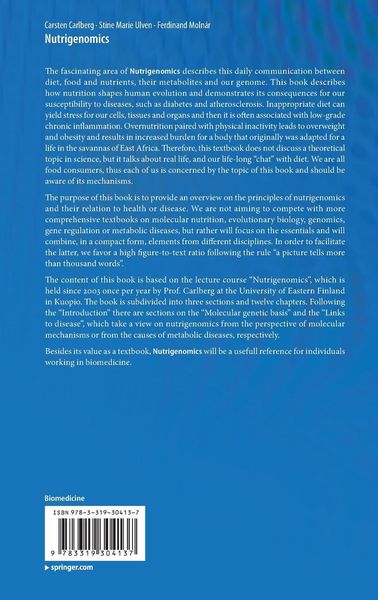
The fascinating area of Nutrigenomics describes this daily communication between diet, food and nutrients, their metabolites and our genome. This book describes how nutrition shapes human evolution and demonstrates its consequences for our susceptibility to diseases, such as diabetes and atherosclerosis. Inappropriate diet can yield stress for our cells, tissues and organs and then it is often associated with low-grade chronic inflammation. Overnutrition paired with physical inactivity leads to overweight and obesity and results in increased burden for a body that originally was adapted for a life in the savannas of East Africa. Therefore, this textbook does not discuss a theoretical topic in science, but it talks about real life, and our life-long "chat" with diet. We are all food consumers, thus each of us is concerned by the topic of this book and should be aware of its mechanisms.   

The purpose of this book is to provide an overview on the principles of nutrigenomics and their relation to health or disease. We are not aiming to compete with more comprehensive textbooks on molecular nutrition, evolutionary biology, genomics, gene regulation or metabolic diseases, but rather will focus on the essentials and will combine, in a compact form, elements from different disciplines. In order to facilitate the latter, we favor a high figure-to-text ratio following the rule "a picture tells more than thousand words".   

The content of this book is based on the lecture course "Nutrigenomics", which is held since 2003 once per year by Prof. Carlberg at the University of Eastern Finland in Kuopio. The book is subdivided into three sections and twelve chapters. Following the "Introduction" there are sections on the "Molecular genetic basis" and the "Links to disease", which take a view on nutrigenomics from the perspective of molecular mechanisms or from the causes of metabolic diseases, respectively.     

Besidesits value as a textbook, Nutrigenomics will be a usefull reference for individuals working in biomedicine.         

Produktdetails

Einband

Gebundene Ausgabe

Erscheinungsdatum

21.06.2016

Abbildungen

XXI, 222 p. 103 illus., 101 illus. in color.

Verlag Springer

Produktdetails

Einband

Gebundene Ausgabe

Erscheinungsdatum

21.06.2016

Abbildungen

XXI, 222 p. 103 illus., 101 illus. in color.

Verlag Springer
Seitenzahl

222

Maße (L/B/H)

24,1/16/1,9 cm

Gewicht

483 g

Auflage

16001 Auflage 1st edition 2016

Sprache

Englisch

ISBN

978-3-319-30413-7

Herstelleradresse

Springer-Verlag KG
Sachsenplatz 4-6
1201 Wien
AT

Email: ProductSafety@springernature.com

Ein neues Kapitel für Ihre Bücher

Ein neues Kapitel für Ihre Bücher

Schenken Sie Ihren alten Schätzen ein zweites Leben und erhalten Sie dafür eine Thalia Geschenkkarte.

Jetzt verkaufen
Jetzt verkaufen

Noch keine Bewertungen vorhanden

Verfassen Sie die erste Bewertung zu diesem Artikel

Helfen Sie anderen Kundinnen und Kunden durch Ihre Meinung.

Kundinnen und Kunden meinen

Bewertungen (0)

  • Produktbild: Nutrigenomics
  • Produktbild: Nutrigenomics

  • Nutrition and common diseases.- Human genomic variation.- Sensing nutrition.- Nutrigenomics: Adapting the human genome to dietary changes and personalized nutrition.- Nutritional epigenomics.- Nutritional signaling and aging.- Chronic inflammation and metabolic stress.- Obesity.- Glucose homeostasis, insulin resistance and β cell failure.- Diabetes.- Hypertension, atherosclerosis and dyslipidemias.- Metabolic syndrome.