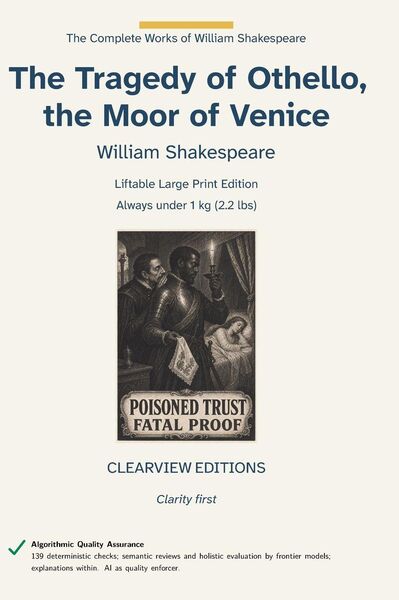
In The Tragedy of Othello, the Moor of Venice, William Shakespeare follows a Venetian general whose marriage to Desdemona is placed under pressure by Iago, an officer who understands how to make uncertainty look like proof. Othello trusts him as an adviser while the audience sees how carefully he selects what to say and what to leave unsaid. The play begins in Venice, where Othello must answer questions about his marriage, and follows the military company to Cyprus. There, distance from the city and the unsettled relationships among the officers give Iago room to work. The plot turns on conversations, staged encounters and objects given meanings that the people around them cannot verify. Cassio's loss of standing gives Iago an opening; Desdemona's efforts to help Cassio become another part of his story. A handkerchief becomes a piece of supposed evidence, even though its movement through the play is known to the audience in a way it is not known to Othello. Emilia, Iago's wife and Desdemona's attendant, sees parts of the action from a different position. The tragedy asks what happens when a person treats another's insinuation as more reliable than direct knowledge of someone they love. Its final scene brings the concealed steps into view at terrible cost. This book contains the complete standalone play: its dramatis personae, five acts and fifteen scenes, from the opening exchange in Venice through Lodovico's concluding speech and the final stage direction. The scene headings and the divisions of dramatic speech remain visible in this newly typeset edition. Readers can follow the movement from Venice to Cyprus, the changes in who knows what, and the difference between a character's spoken claim and the action the audience has witnessed. Othello can be read as a tragedy of jealousy, but it also places questions of trust, military command, reputation, race, friendship and marriage inside the action rather than treating them as abstract topics. The electronic source for this printed text is the Othello section of Project Gutenberg ebook 100, The Complete Works of William Shakespeare. The selected section begins at the Othello heading and ends after the play's final [Exeunt.]; it stops before the following Pericles section. The source identification gives readers a definite text to consult, while About This Edition explains the publisher's production choices and their limits. This edition does not claim to settle the play's textual history or to replace an annotated scholarly edition. Clearview Editions presents the text as a 7-by-10-inch casebound large-print book with approximately 18-point Atkinson Hyperlegible Next body type. The layout gives dramatic speakers, verse lines and scene changes room to be distinguished at reading size. A contents page and PDF bookmarks help a reader locate the play's acts and scenes; the printed book also identifies its ISBN, format and other physical specifications. The large-print design is intended for readers who prefer more spacious type and for library collections that need a separately bound reading copy. In the publisher's catalog, this is title 25 in The Complete Works of William Shakespeare series. That number gives its position in the series; it does not mean that Othello has been cut into 39 parts. Each play is separately catalogued under its own ISBN, and the complete Othello play is contained in this one hardcover. Libraries can acquire this title on its own for Shakespeare, drama or large-print shelves. The series designation, edition label and page count describe this physical book, while the work title remains The Tragedy of Othello, the Moor of Venice.